
Healthcare IT Consulting: A Complete Guide to Services, Benefits, and Solutions
Healthcare IT consulting is expert help for the technology side of a healthcare organization. Opting for this specialized advisory and technical support will help you by providing a consultant who reviews the system you use, explains what needs to change, and guides you through the work, from choosing an EHR to meeting compliance rules such as HIPAA.
Most clinics, hospitals, and health startups look for it at a turning point, typically when a contract is ending, an audit is coming, or systems that should share patient data still don’t.
If you’re interested in knowing what consultants actually do, where they really add value, what the work costs, and how to choose the right partner, then continue to scroll through this guide and you’ll have a clear answer by the end.
What Is Healthcare IT Consulting?
Think of it as a bridge between the people who deliver care and the technology they rely on. Clinical staff know what they need from their systems, and software vendors know what their products can do. And here, a consultant can help line up both. You may also see this called healthcare technology consulting.
What a Healthcare IT Consultant Does
A consultant starts by studying how your teams work and which systems they use. They point out where things slow down or put patient data at risk, then on the basis of that they recommend a realistic plan. Many stay through the rollout, from choosing a vendor to training staff. Unlike general IT consulting, the work centers on clinical workflows and patient privacy rules.
Who Needs Healthcare IT Consulting
Healthcare IT consultants work with many kinds of organizations:
- Hospitals and health systems: linking large systems and keeping them secure
- Clinics and practices: choosing an EHR and handling compliance with a small team
- Digital health startups: building products that meet privacy rules early
- Payers: improving how claims and member data move
- Medtech and pharma companies: meeting regulatory expectations for connected products
Healthcare IT Consulting Services
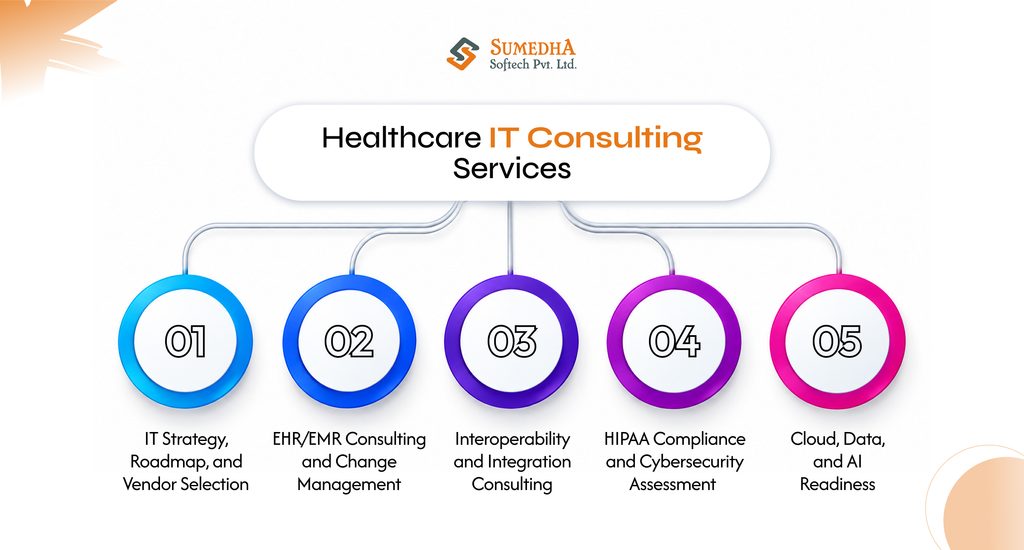
Healthcare IT consulting services cover a wide range, but most requests fall into five areas. Some organizations need one, while others need several in sequence. Here is what each one involves and what you should expect to receive at the end.
IT Strategy, Roadmap, and Vendor Selection
A strategy engagement starts with a simple question: where is your technology today and where does it need to be in a few years?
The consultant reviews your systems, staffing, and budget, then builds a roadmap with priorities and timelines. Vendor selection often sits inside it. Healthcare software consulting helps you compare options against your actual workflows, not a vendor’s demo, and read contract terms before you sign. You end up with a ranked plan and a clear shortlist.
EHR/EMR Consulting and Change Management
Few projects shape daily work as much as an EHR. A consultant helps you define what clinicians and billing staff actually need, compare platforms, and plan the move, including how old records get transferred.
They also prepare people for the change, like training, a support plan for go-live week, and a check-in afterward to fix what is not working. Even a good platform frustrates staff when it does not fit how they work, so this step matters.
Interoperability and Integration Consulting
Interoperability means your systems can exchange patient data and understand it. A consultant maps how data moves today, finds the gaps, and designs the connections between systems. This is where standards such as HL7 and FHIR come in.
FHIR is the newer, API-based standard that U.S. regulators and large networks increasingly expect. Consultants also help organizations prepare for national exchange networks such as TEFCA. The result is data that reaches the right clinician without manual re-entry.
HIPAA Compliance and Cybersecurity Assessment
HIPAA requires covered entities and business associates to complete an accurate and thorough risk analysis, and a consultant can help you run it.
They help you map where patient data lives, assess the safeguards around it, and rank weak points by risk. You receive a written report and a fix list in priority order. Cybersecurity work often adds access reviews, staff training, and an incident response plan, so a problem is handled quickly instead of improvised.
Cloud, Data, and AI Readiness
Many organizations are weighing a move to the cloud, better reporting, or AI tools. A consultant checks whether your infrastructure and data are ready before money is spent. That includes how safely data is stored, whether records are clean enough to analyze, and whether vendors have signed business associate agreements.
AI integration in healthcare, such as note summaries or scheduling tools, works best when the data underneath it is accurate, and the privacy rules are settled first.
Benefits of Healthcare IT Consulting
The value of a consultant shows up in decisions and in time saved. Most benefits come from choosing the right healthcare technology solutions the first time and from having someone who has handled similar projects before. Here are the benefits that matter the most to healthcare teams.
Key Benefits for Healthcare Organizations
- Fewer Compliance Gaps: A review before an audit finds problems while they’re still cheap to fix.
- Better Adoption: Systems are set up around how staff really work, so people actually use them.
- Fewer Costly Mistakes: Someone who has seen similar projects can flag a weak vendor or an unrealistic plan early.
- Cleaner Data Exchange: Connected systems mean less retyping and fewer errors.
- Flexible Expertise: You bring in specialists for a project without a permanent hire.
Meanwhile, to judge the results, track a few numbers: compliance findings closed, system uptime, time to go-live, and spend against plan.
When You May Not Need a Consultant
If your needs are routine, such as password resets, device setup, and day-to-day support, a consultant is probably the wrong tool. A managed IT provider or in-house IT staff fits that work better. Bring in a consultant for decisions and projects: a new EHR, a compliance review, or a major integration.
Healthcare IT Solutions: What to Choose and When
Healthcare IT solutions come in many forms, and picking the wrong one is an easy and expensive mistake. The better approach is to start with the problem, not the product. Once the problem is clear, the right solution is usually easier to spot.
Common Problems and the Solutions That Fit
This table pairs six common problems with the solutions that usually fit and what a consultant adds.
| Problem | Likely Solution | What Consulting Adds |
| Disconnected systems | Integration layer | Architecture and roadmap |
| Poor patient access | Patient portal or app | Workflow assessment |
| Revenue leakage | Revenue cycle tools | Process review |
| Legacy software | Modernization or migration | Risk assessment and plan |
| Security exposure | Security assessment and controls | Gap findings and fixes |
| Underused data | Data platform and analytics | Data governance design |
A consultant’s job is to confirm the problem first, so you don’t buy a fix for the wrong issue.
Off-the-Shelf, Custom, Integrate, or Replace
For common needs, buying proven software is usually the safer start. It launches faster and costs less upfront, which suits tools like scheduling or messaging. Custom software makes sense when your workflow is unusual or no compliant product fits.
Many organizations land in between. They keep a commercial EHR and build custom tools around it using its APIs. Plan for upkeep, since vendor updates can break custom connections. Replacing a core EHR is a bigger step, so first check whether fixing or extending it solves the problem.
If the gap involves AI, such as a tool trained on your own data, an AI development company can build it, but test it against your privacy rules first.
Healthcare IT Regulations and Trends to Plan For
Rules here change often, so treat this as a map, not legal advice. Three areas affect most technology decisions: how data is exchanged, how it is secured, and which laws apply to the data you hold.
Interoperability: FHIR, TEFCA, and Prior Authorization APIs
FHIR is the standard regulators now point to for exchanging health data, and TEFCA is a national framework that helps networks share it. The clearest deadline comes from CMS-0057-F: by January 1, 2027, Medicare Advantage plans, Medicaid and CHIP programs, and federal marketplace insurers generally must run four FHIR-based APIs, including one for prior authorization. The rule binds payers, but providers will notice it in prior authorization, so confirm your EHR can connect.
Security and AI Under HIPAA
The current Security Rule is in force, and OCR enforces it. A major update was proposed in January 2025, but it is not final, and federal planning documents now target July 2027, a date that has already been moved. Basics such as risk analysis, encryption, and access controls help under either version. If an AI tool touches patient data, HIPAA covers it like any other system, so the vendor typically needs a business associate agreement, and your risk analysis should include it.
Regional Compliance: HIPAA, GDPR, and the DPDP Act
Which laws apply depends on where you operate and whose data you handle. HIPAA governs health data held by U.S. covered entities and their business associates. GDPR protects personal data of people in the EU. India’s DPDP Act covers digital personal data, and its main obligations take full effect in May 2027.
How a Healthcare IT Consulting Engagement Works
Most engagements follow the same arc, whether the goal is a new EHR or a security review. Knowing the steps helps you judge a proposal and spot what is missing. Timelines vary with scope, from a few weeks for an assessment to many months for a full rollout.
The Five Steps
- Discovery: Interviews with clinical, billing, and IT staff to understand how work really happens.
- Assessment: A review of systems, security, and data flow, ending in a written findings report.
- Roadmap: Priorities, budget, and a phased plan, with clear limits on what is and isn’t included.
- Implementation Support: Project oversight, vendor coordination, testing, and staff training.
- Handover and Ongoing Advisory: Documentation, admin access, and training so your team can run the system, with optional support afterward.
Breaking the work into phases lets you re-scope or stop between steps.
What to Prepare Before the First Call
You’ll get more from the first conversation if you bring a few things:
- A list of the systems you use today, including vendors and contract end dates.
- Your top three problems, in plain words.
- Any recent audit or risk analysis reports.
- A rough budget range and a target date.
Buy, build, or fix what you already have?
Bring us the system, the deadline, or the problem. We’ll tell you what to fix first.
How Much Does Healthcare IT Consulting Cost?
There is no standard price for this work, because scopes differ so much. What you pay varies depending on how the engagement is structured and how much is unknown at the start. This section explains how to read a proposal and what to ask before you sign.
Common Pricing Models
- Hourly or Time and Materials: You pay for hours worked. It suits unclear scope, but costs can drift without regular check-ins.
- Fixed Fee: A single agreed price for a defined scope. It suits a clear deliverable, though anything outside the scope is priced separately.
- Monthly Retainer: A set fee for ongoing advice or support.
- Phased or Milestone-Based: Payment tied to each completed stage, which makes large projects easier to review.
What Affects the Price
Price follows effort and risk. The biggest factors are the size of the scope, how many systems are involved, and how deep the compliance work goes. Seniority of the team and on-site versus remote work matter too, and rates vary by region. Because of this, published figures differ widely, so ask for a quote based on your situation.
Questions to Ask Before You Sign
Ask these before work starts:
- What exactly is included, and what is not?
- What triggers a change order, and at what rate is extra work priced?
- Who will actually do the work, and how senior are they?
- What do we receive at the end, including documentation and system access?
Get vague answers in writing.
How to Choose a Healthcare IT Consulting Company
A good choice here comes down to proof, not promises. Almost every firm says it knows healthcare and HIPAA, so your job is to ask for evidence. These checks separate real expertise from a good sales pitch.
What to Look For
Ask each firm the same questions so you can compare answers side by side.
- Healthcare Experience That Matches Yours: Ask for references from organizations like yours, ideally running the same EHR or systems you use.
- Security and Compliance Depth: They should test real controls, not only write policies.
- Workflow Understanding: The people assigned should know how clinicians work, not only the technology.
- Clear Deliverables: Written findings, project plans, and diagrams you keep.
- Help After the Report: Ask whether they will help fix what they find or only list it.
- A Business Associate Agreement: If they’ll see patient data, they must sign one first.
- The Actual Team: Meet the people who will do the work, not only the sales lead.
When you call a reference, ask what went wrong and how the firm handled it.
Red Flags to Watch For
Walk away, or ask harder questions, if you see any of these:
- Promises of HIPAA certification or guaranteed compliance, since no official certification exists.
- No healthcare references or vague answers when you press for detail.
- Big promises on a very small budget or short timeline.
- A proposal that reads like a product pitch.
Consultant vs. In-House Team vs. Managed IT Provider
These options solve different problems, and many organizations use more than one.
| Option | Best For | Limit |
| Consultant | Decisions, projects, assessments | Usually temporary |
| In-house team | Daily operations and continuity | Hard to cover every specialty |
| Managed IT provider | Ongoing monitoring and support | Strategy depth varies |
A common mix is an in-house team for daily work and a consultant for big decisions.
Conclusion
Choosing the right partner starts with a clear problem, a realistic scope, and proof that the firm has done similar work. Name what is not working today, then use the questions in this guide to compare your options. A good partner gives you plain answers, written deliverables, and a plan your team can follow after the engagement ends.
If you would like a single team for both the planning and the build, Sumedha Softech can help. As a custom software development company, it works with healthcare organizations to assess current systems, shape a roadmap, and build the applications, integrations, and AI-enabled tools that the roadmap calls for. You get a team that understands the plan and the code behind it.
Ready to talk it through? Book a consultation and bring your biggest technology question.
Frequently Asked Questions
What does a healthcare IT consultant do?
A healthcare IT consultant reviews your systems, finds problems, and recommends a practical plan, often staying through the rollout. The work can include EHR selection, interoperability, security reviews, and staff training, all with patient privacy rules in mind.
How much does healthcare IT consulting cost?
It depends on the scope, the systems involved, and how experienced the team is. Hourly, fixed-fee, retainer, and phased pricing are all common. The most reliable answer is a written quote based on your situation, with inclusions and change-order terms spelled out.
How long does a healthcare IT consulting engagement take?
A focused assessment can take a few weeks, while a full EHR or integration project often runs for many months. Scope, the number of systems, and how quickly your team can make decisions all affect the timeline. Ask for a phased schedule with clear milestones.
Do small practices need a healthcare IT consultant?
Often yes, but for specific projects rather than daily support. A small practice benefits most when choosing an EHR, preparing for an audit, or connecting systems. For routine help desk needs, a managed IT provider or in-house support usually fits better.
Does HIPAA apply to AI tools?
Yes, when the tool handles patient data. HIPAA covers protected health information no matter which technology processes it. That means the vendor typically needs a business associate agreement, and the tool should be part of your security risk analysis.