
How to Choose a Travel Software Development Company
Somewhere between the idea and the launch, most travel platforms run into the same wall. The booking flow looks fine on paper, then a GDS response comes back in a format nobody planned for, or a payment fails silently during a currency conversion, and suddenly a three-month project stretches into eight months. This is usually the point where founders realize the real challenge was never the idea; it was picking the right travel software development company to build it.
That choice matters more in travel than in most other industries. A booking engine handles real money, dates, and expectations. It’s the thing standing between a traveler and a confirmed reservation. Get the partner wrong, and you end up rebuilding, not just running behind schedule.
This guide walks through exactly what to look for, what to ask, and what should make you walk away, so you can make the decision with confidence instead of guesswork.
What to Look For in a Travel Software Development Company
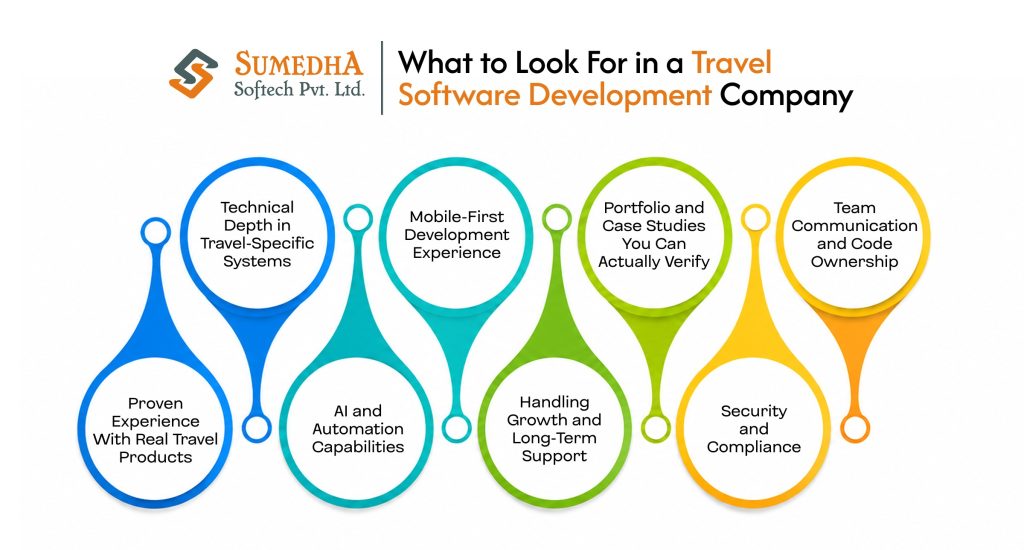
Not every company that lists travel on its website actually understands it. Before you shortlist anyone, here’s what genuinely separates a partner who can handle a travel platform from one who’s guessing along the way, based on what actually matters once real users show up.
Proven Experience With Real Travel Products
Ask to see something live, not a mockup. A booking engine that is handling real reservations, or a travel app development company with an app people are actually using to plan trips. Real products reveal real experience; homepages don’t.
Technical Depth in Travel-Specific Systems
Travel software runs on things that most developers rarely touch: GDS connections, NDC standards, PMS integrations, multi-currency payments. Ask them how they would connect two GDS providers and merge the results into one clear search. Their answers will tell you everything.
AI and Automation Capabilities
The use of AI in travel industry has moved past chatbots. Look for real personalization, smart pricing, and search that actually understands what someone’s looking for. A partner who’s actually built these features will explain them simply, not vaguely.
Mobile-First Development Experience
Most travellers now make their bookings from their phones, not their laptops. Good travel app development means building for that reality from day one, not adapting a desktop version later. A strong mobile app development partner designs with the phone as the starting point, not an add-on.
Handling Growth and Long-Term Support
Bookings during the holidays and sales generally get higher, and your platform needs to survive that without crashing, and your partner needs to still be around afterward for fixes, updates, and the inevitable “can we add this” requests.
Portfolio and Case Studies You Can Actually Verify
Don’t simply settle for screenshots. Instead, ask them for live links, real outcomes, and permission to speak with a past client directly. A company that is confident in its work will hand these over without any hesitation.
Security and Compliance
Travel platforms handle payments and personal data across borders, so compliance isn’t optional. A serious partner brings up data protection and payment security on their own, before you even have to ask.
Team Structure, Communication, and Code Ownership
Know who you’re actually working with day-to-day, and make sure up front that you own the code once it’s built. This single detail decides how easily you can grow or switch partners later.
Questions to Ask Before You Sign
A good conversation with a potential partner tells you more than any pitch deck ever will. Here are some questions worth asking before you commit, the kind that quietly separate the companies that know travel from the ones who are still figuring out.
Q1. Can you walk me through a travel platform you’ve actually built?
Ask them how the booking flow works, what happens when a reservation fails, and how they handle edge cases. Real builders will answer this question without any hesitation.
Q2. How would you connect two different GDS providers into one search result?
This single question filters out a lot of people fast. If they can explain merging Amadeus and Sabre data into one clean response, that means they’ve done this before; therefore, if they look unsure, they haven’t.
Q3. Who exactly will be working on my project?
Ask for names, roles, and how much travel experience each person actually has. A senior developer on the sales call and a junior team doing the actual build is a common bait-and-switch.
Q4. What happens after launch?
Find out what type of support they will provide once the platform is live. Bug fixes, updates, and scaling help, is that included, or does the relationship end the moment you go live?
Q5. Who owns the code once it’s finished?
The answer should be a simple yes, not a negotiation. If a company pauses here, that’s worth noticing early, not after the contract is signed.
Q6. How do you handle payment security and data compliance?
A partner who’s done this before will bring this up unprompted. And if you have to ask first, that’s usually a sign they haven’t dealt with it much
Run a Small Paid Pilot Before Committing
Before you sign a long contract, it’s better to ask for a small paid project first. Something like a two- or four-week piece of work, a single feature, or a working prototype of one part of your platform. Nothing can tell you better about a company than actually working with them.
A sales call shows you what a company wants you to see. But a pilot shows you how they actually work. You’ll notice how they communicate when something doesn’t go as planned, how clearly they explain technical decisions, and whether the senior people from the pitch are the same ones who will be writing the code.
It also protects you. If things don’t click, you’ve lost a few weeks and a small budget, not six months and a large one. And if it goes well, you’ll walk into the full project already knowing what it feels like to work together, which is worth more than any portfolio.
Most companies confident in their work won’t step back, whereas the ones who push back or insist on a full contract upfront are usually telling you something too.
Red Flags to Watch For
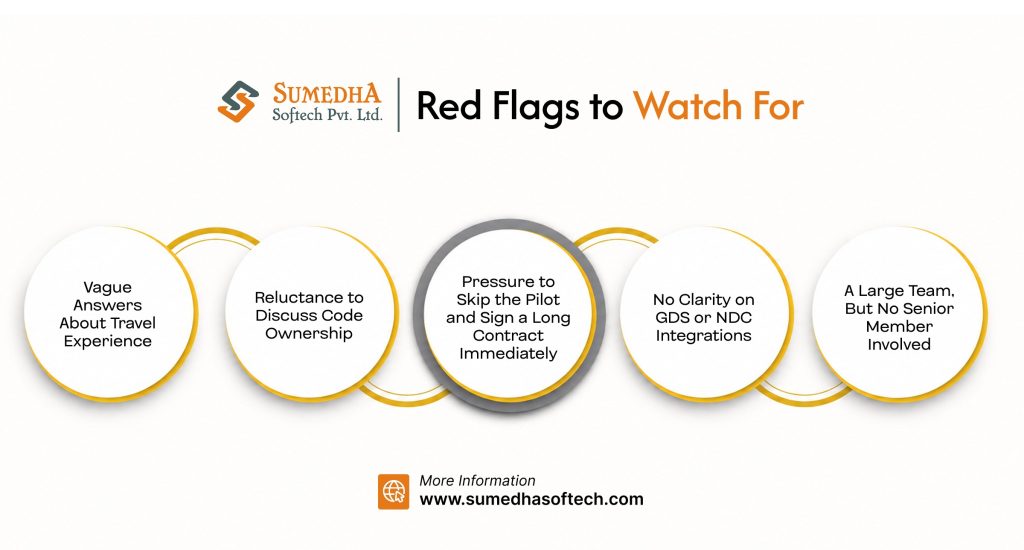
Some warning signs show up early if you know what to look for. Here’s what should make you pause before moving forward with a travel software development company, no matter how good the pitch sounds.
Vague Answers About Travel Experience
If “we’ve worked in travel” isn’t followed by an actual project, real link, or specific example, that is usually because there isn’t one.
No Clarity on GDS or NDC Integrations
The moment you ask technical questions related to how bookings actually connect to suppliers, or there is no clarity on GDS or NDC integrations, that discomfort directly shows up later in your project, too.
Reluctance to Discuss Code Ownership
This should be a simple, upfront answer. Any awkwardness here almost always turns into a bigger problem down the line.
Pressure to Skip the Pilot and Sign a Long Contract Immediately
Patience is the real tell. A company sure of its work has no reason to rush you into anything.
A Large Team, But No Senior Member Involved
Big numbers on a website don’t mean much if your project ends up in junior hands.
None of these mean walking away instantly. But together, they tell you a lot about what working with that company will actually feel like once the contract is signed.
How Much Does Travel Software Development Cost?
The right answer for this depends. Cost really comes down to what you’re building. A simple booking flow with one supplier will cost slightly less than a platform juggling multiple GDS providers, live pricing, and multi-currency payments.
What often surprises people is that experience matters more than the feature list. A team that already understands travel systems moves faster and avoids costly mistakes. A cheaper, inexperienced team might quote less upfront, but that gap usually shows up later as delays and rework.
The best way to get a number that actually means something is to share your specific idea with a few companies and compare what they’re actually proposing to build.
Conclusion
In the end, choosing the right travel software development company isn’t about finding the biggest name or the lowest quote. It’s about finding people who’ve actually solved these problems before and are willing to prove it before you commit.
If you’re ready to hire a dedicated development team that understands travel from the ground up, then connecting with Sumedha Softech will definitely bring something to the table. From real technical depth in travel systems to full code ownership handed to you from day one, we build with the same care we’d want if it were our own product. In contrast, we would love to hear what you’re building and talk through how we can help bring it to life, no pressure, just a genuine conversation.
Frequently Asked Questions
Q1. What is the difference between GDS and NDC integration?
GDS is the old reliable, the wide network airlines and hotels have used for years. NDC is the newer path, giving airlines a way to share richer details like seat picks and bundled fares directly. The best platforms use both.
Q2. How long does it take to build a travel booking platform?
A basic version can be ready in a few months. Add live pricing, multiple integrations, and compliance, and you’re realistically looking at nine months to a year.
Q3. Do I need a travel-specific developer or a general app developer?
Technically no, but practically yes. Travel comes with its own maze, supplier connections, fare logic, and real-time availability. A team that’s navigated it before saves you from learning the hard way.
Q4. What is the average cost of a travel booking engine?
There’s no single number. A simple flow costs a fraction of what a multi-supplier, multi-currency platform runs. The real answer comes from sharing your idea and comparing what a few teams quote back.
Q5. Should I hire a dedicated development team or a freelancer?
For anything with real complexity, a dedicated team wins; they bring structure and stick around. Freelancers are fine for small, quick tasks, but not for something you’ll depend on long-term.