
How to Choose a Custom Software Development Company
Choosing a custom software development company can feel complicated. Every vendor promises experienced developers, modern technology, and successful projects, but those things alone don’t tell you who can actually deliver what your business needs.
The right choice goes beyond comparing prices and portfolios. You need to assess technical expertise, understand who will build your software, verify their past work, compare proposals, and know what questions to ask before signing a contract.
This guide walks you through the key factors to evaluate so you can choose a software development partner with confidence.
Watch How They Handle Your First Brief
The first thing that will tell you about the company is their way of responding. For example, send the same project brief to 4 different vendors, and you’ll usually receive the four nearly identical quotes back within 48 hours. That speed feels efficient, but it’s actually the first warning sign.
The project brief is never the full picture; it’s generally your attempt at describing a problem you’re facing and trying to figure out. However, without asking a single question, if any software development company briefs you with the price, then either they’ve seen the exact problem like yours multiple times (rare), or they’re simply quoting the words on the page instead of the problem behind them (this can be common and expensive later).
What you want to see here is good friction: questions about what happens when two workflows conflict, who actually uses a feature you think is simple, and whether a deadline realistically matches the scope. That’s not a vendor being difficult; it shows how they think.
And don’t just stop at the call. Make sure to read the proposal itself. Here, a serious one will name its assumptions and spell out what’s excluded from scope, whereas a vague one will leave both blank, which is exactly where change-request arguments come from after starting the project.
Find Out Who Really Owns What You’re Paying For
Here’s another important thing that most of the people skip asking: if you had to leave this vendor tomorrow, could you actually walk away with everything that’s yours?
Ownership sounds obvious until you test it. Ask the vendor where the code lives. Is it in a repository you have access to from day one, or does it sit on the vendor’s servers until handover at the end? Also ask what the contract says about intellectual property, not what the sales deck implies.
A trustworthy software development partner should be able to answer both questions clearly. At this point, a vendor that stays quiet or does not give a clear answer is hiding a problem or a bad deal.
Then there’s a risk almost nobody brings up: what happens when the one person who understands your project leaves the company mid-build? It generally happens more often than clients expect, so it’s always better to ask directly—do decisions and technical context live in shared documentation, or only in that one developer’s head? The answer will tell you whether your project will run smoothly or collapse with it.
In addition, in 2026, there is one more question worth asking, and one that you won’t find on most vendor checklists: how much of your codebase will be AI-assisted, and how do they review it before it ships? This isn’t about whether AI tools are used; it’s about whether there’s a genuine human review process behind the code before it ships.
Look Beyond the Portfolio to Judge Their Experience
A portfolio page is marketing copy with screenshots attached, not a complete objective record of their work. So, it’s better to start by ignoring industry matches.
If you run a logistics company, then it doesn’t mean that you need a vendor who’s only built logistics software before; instead, look for those who have handled the same kind of complexity, like multi-user permissions, real-time data syncing, and third-party integrations before. That will be a better predictor than a matching label on a case study.
Then ask the question most people skip: what was their actual role in this project? There are a number of custom software development companies that show off work that was co-built with another team, inherited mid-project, or partially subcontracted. However, none of those things disqualifies a vendor on its own, but if they can’t clearly explain what they personally owned, then treat that case study as unverified.
The best way to judge a team’s true character and capability is by looking at how they handle failure, not how they celebrate success.
Match the Deal Structure to Your Actual Project
Fixed price feels safer. Time-and-materials feels flexible. Neither one is right or wrong, but the mistake is picking a pricing model based on what sounds reassuring instead of what actually fits your project’s goals.
If your scope is genuinely locked, then you know exactly what’s being built, and it isn’t going to shift. But if you’re not sure about building something that’ll evolve as you learn, fixed price quietly turns every new idea into a negotiation. A custom software development services provider that just pushes fixed-price contracts for a project with unclear requirements does not actually save you money; instead, they charge you an extra, hidden premium to cover their own risk.
Therefore, communication needs the same clarity. “We communicate well” doesn’t tell you much on its own. Ask for actual overlapping working hours across time zones, and ask what their written response time looks like when something urgent comes up, outlining that window.
Then there’s a detail that almost no one reads until there’s actually a problem, and that is the governing law and dispute-resolution clause buried in the contract. If you’re choosing an offshore or nearshore software development company, it will determine which country’s laws govern your contract and dictate how legal disputes will be handled if your software project goes wrong.
Don’t Commit Until You’ve Run a Paid Trial
Everything up to this point was about listening carefully to what the vendor says, but this is the different stage where you stop listening and start watching.
Before signing a full engagement, ask them for a small, paid trial, which can be a sprint, a clearly scoped feature, or a short discovery-to-prototype phase. Most of the well-established software development agencies will agree to this without any hesitation, but the ones that refuse to compromise are giving away warning signs about how they operate.
During the trial, you’re not just grading the output alone but also grading the behavior around it. Did they hit the estimate they gave you, or quietly slip the timeline? Is the code actually documented and reviewable, or does it only make sense to the person who wrote it? And here is the real test: asking them for minor changes during a trial period is the best predictor of their long-term performance and reliability.
Instead of relying on what other people say, a trial run lets you see exactly how the team handles your specific problem as a guarantee before you commit to a major contract.
Warning Signs You Shouldn’t Ignore
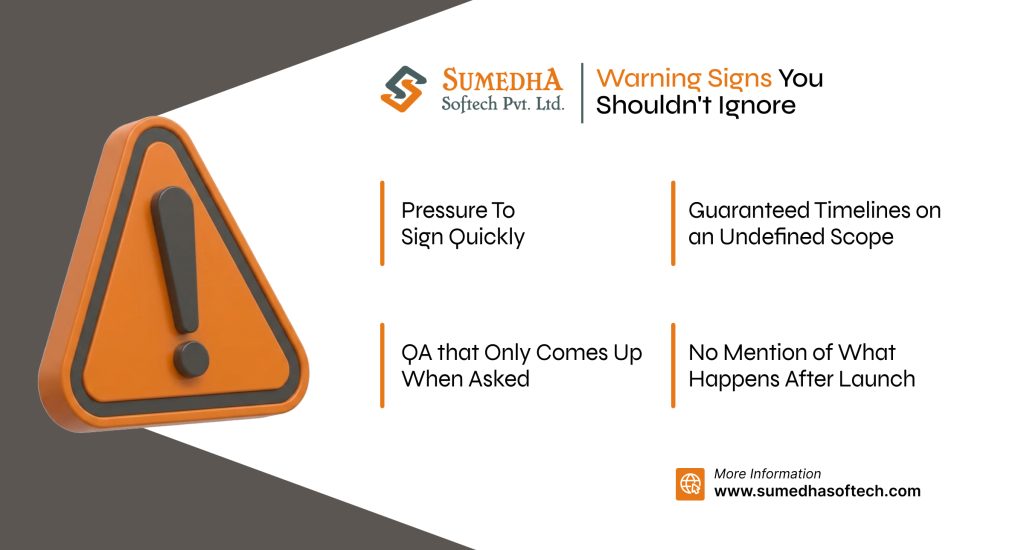
Other than the above point, there are a few signals that are worth flagging on their own, and you must acknowledge them before it’s too late.
- Pressure to Sign Quickly – Anyone who tells you that this rate’s only good this week, this artificial urgency around pricing or contract signing, should be treated as a warning sign.
- Guaranteed Timelines on an Undefined Scope – Nobody can promise a delivery date for a project that hasn’t been properly scoped yet, and a vendor that does so is just simply guessing, not planning.
- QA that Only Comes Up When Asked – Quality assurance should always be part of how they describe their own process unprompted, not something you have to dig for.
- No Mention of What Happens After Launch – If a custom software development company only talks about delivery and never about the month that follows, then they’re just planning around the sale, not around your product.
Ready to Choose the Right Software Development Partner?
Make a confident decision with the right team, delivery model, and approach for your custom software project.
What to Do When No One Passes All Five Tests
Here’s the important part: no vendor is going to score perfectly on every test. There will be somebody who will nail the discovery call but hesitate on a paid trial. Somebody else will have a spotless portfolio but get vague about AI code review. So, that’s normal, but the point was never to find a perfect scorecard but to know which gaps you can live with and which ones you can’t.
Start by ranking the five tests against what your specific project actually risks. A simple internal tool with a fixed, unchanging scope can survive a vendor who’s a little slow to warm up in discovery. A fast-evolving product, especially one involving generative AI development or something you’ll keep iterating on for years, requires more flexibility and may benefit from a different engagement model.
After all your analysis, once you’ve got two or three finalists, don’t score them separately in your head and compare gut feelings later. Run all of them through the same five tests, side by side, and write down exactly where each one fell short.
At the end, if you only hold the line on one thing, make it ownership. A slow communicator can improve. A confusing pricing model can be renegotiated. Unclear code ownership, discovered after the fact, is the one mistake that’s genuinely expensive to undo.
Conclusion
Here’s the end of this guide, and at the end, choosing a custom software development company comes down to one thing: will they think through the problem with you or just execute whatever you hand them?
All five tests in this piece point at the same underlying question. A strong vendor pushes back during discovery, is transparent about ownership, can talk honestly about projects that went wrong, structures the engagement around your project’s reality, and is willing to demonstrate how the team works before you make a major commitment. The architecture decisions, ownership terms, and the trade-offs made early in a project outlast the contract by years. Meanwhile, the right team surfaces those decisions instead of quietly making them for you.
At Sumedha Softech, this is the same standard we hold ourselves to with every client. Whether it’s a startup building its first MVP or an enterprise team modernizing a system that’s outgrown itself. We don’t just take a brief and build to it. We ask the harder question first, because we understand and have years of experience where the real work of a good software development partner actually happens.
Frequently Asked Questions
Q1. How long should discovery take before I get a real quote?
It depends on complexity, but expect anywhere from a few days to two weeks. If a vendor hands you a full quote without any real discovery conversation first, that’s a signal worth paying attention to.
Q2. Is a paid trial or pilot sprint normal to ask for?
Yes, and it should be. A solid software development company will be comfortable with it, since it’s a small cost compared to committing to a full engagement without ever watching them work.
Q3. Fixed price or time-and-materials—which should I pick?
Fixed price works when your scope is locked and unlikely to shift. Time-and-materials suits a product that’ll keep evolving. Choose based on your project’s actual shape, not whichever option feels safer.
Q4. Why does it matter how much of my code is AI-assisted?
AI-assisted coding isn’t the concern by itself, because most serious teams use it today. What actually matters is whether a genuine human review process sits behind that code before it ever ships.
Q5. What if no vendor has direct experience in my exact industry?
Prioritize similar technical complexity over an industry match. A team that’s handled comparable challenges like integrations, permissions, and real-time data usually serves you better than one that only matches your industry on paper.
Q6. How important is it to know who’ll actually work on my project?
Very important. Senior staff often appear on sales calls, while a different, less experienced team quietly handles the actual build. Ask directly who’s assigned, and expect a specific, confident answer in return.