
Travel App Development: Features, Cost & Process
Over the past few years, the travel industry has gained some mind-blowing growth, and that growth is not shown in just rising tourism but also in technology. A few years ago, people who wanted to plan their trip had to browse multiple tabs, and that habit is fading fast. Travelers now expect to do it all from one app, where they can search flights, compare hotels, check reviews, and make payments without ever opening a desktop site. And this is exactly where travel app development has become a top priority.
Travel brands, OTAs, and hospitality companies who don’t want to lose bookings to competitors are heavily investing in a better app experience. But to get the most out of it, partnering with the right travel app development company is a must. In this blog, we’ll walk through the features, cost, and process that travel app development needs.
What is travel app development?
Travel app development is the process of building a mobile or web application that lets travelers search, book, and manage trips at one stop. Whether it’s about booking flights and hotels or wanting itineraries and local recommendations, they’ll get everything.
The app development falls under the broader umbrella of travel software development, which also includes backend systems like booking engines, payment processing, and inventory management. For a travel business, this usually means working with travel app developers who understand both mobile engineering and the travel industry’s specific needs: real-time pricing, multi-currency support, and integrations with global distribution systems.
Why Travel Businesses Are Investing in Apps Right Now
There are multiple reasons behind why travel businesses are investing in apps, but if you look at the core factors, then these three things are pushing faster than before.
Booking Behavior
Most travelers now start and finish a booking on their phone, and a business without a solid app is competing with one hand tied behind its back.
Real-Time Updates
Travelers expect real-time updates. Whether it’s a flight delay, gate change, or price drop, none of that works well via email or mobile website; it really needs push notifications and a proper travel booking platform built for speed.
Direct Bookings & Revenue
Every booking made through an OTA comes with a commission cut, which directly impacts margin. But by building your own travel booking platform, businesses can bring bookings in-house, reduce third-party dependency, and keep more revenue themselves.
Types of Travel Apps
Not every travel app solves the same problem, and the type you’re building changes almost everything about scope and cost. Here’s how travel apps generally break down:
Booking and OTA-Style Apps
These apps handle the actual searching, comparing, and booking of flights, hotels, and travel packages. It’s what most people picture when they hear “travel booking platform,” and it usually needs strong integrations for real-time pricing and availability to work the way users expect.
Itinerary and Trip Management Apps
These apps’ primary focus is on organizing what’s already booked rather than finding new bookings. In this type of app, users can easily access digital itineraries, get reminders, and manage schedules seamlessly.
Travel Companion Apps
These apps typically cover the smaller but very useful stuff for travelers, including offline maps, currency conversion, and translation tools, all aimed at maximizing the overall travel experience.
Corporate Travel Apps
Corporate travel apps add an additional layer that consumer apps skip entirely. These types of apps work well with approval workflows, expense tracking, and policy compliance for business travelers.
Niche Travel Apps
These apps target specific travel segments, like cruise booking, adventure tourism, and vacation rental management. Each niche comes with unique user expectations and requires tailored backend integrations and features.
These are some types of travel apps, and knowing which types you’re building early matters a lot. No matter which type you choose, Sumedha Softech helps you turn it into a scalable, high-performing product.
Must Have Travel App Features
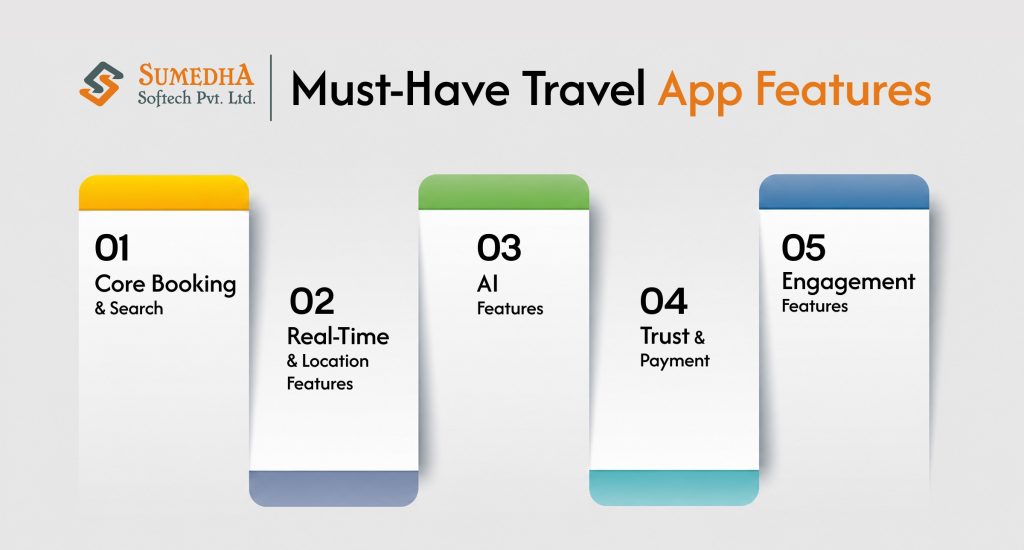
The main thing behind a travel app’s growth is its features that solve travelers’ real problems in the moment, not how many features it lists. If you’re planning to build your own travel app, then here’s the list of features that separate apps people keep using.
Core Booking & Search
This is the part that users normally judge within the first thirty seconds of opening the app.
- Search needs filters that actually narrow things down, like dates, price range, and amenities, not just a keyword box.
- Price comparison across airlines or hotels saves users from the trouble of checking other apps before committing.
- For fast checkout, a booking app should offer quick booking options instead of taking multiple screens to confirm.
Real-Time & Location Features
Static information quickly becomes useless once a traveler is actually on the move.
- GPS navigation and offline maps matter the most when signal is weak, think airports, remote areas, or anywhere where roaming gets expensive.
- Live flight or transport tracking helps users to get real-time updates and stops them from refreshing a browser tab and waiting for an update.
- Push notifications when the gate changes, prices drop, and other travel-related updates, which turns a one-time booking app into something people leave installed.
Personalization & AI Features
This is the feature where a lot of travel software development is heading toward.
- AI-based recommendations that learn from past searches and make booking feel less like ads and more like a travel agent who remembers your preferences.
- Smart itinerary builders that auto-arrange bookings by date and location, saving real planning time.
- Chatbots for repetitive questions like visa requirements and baggage limits, so support teams don’t have to answer the same thing often.
Trust & Payment
Nobody hands over card details to an app that feels shaky.
- Secure, multiple-gateway payments including cards, wallets, and region-specific methods while removing friction at checkout and building confidence.
- Verified reviews helping travellers to make the best decision, not just marketing copy.
- Clear cancellation and refund policies that show upfront rather than buried in terms and conditions cut down on support tickets after the fact.
Engagement Features
Getting some to download your app is only half of the job, but keeping them coming back is the other half.
- Give users loyalty programs that reward them in return; give users a reason to stick with one app instead of browsing multiple.
- In-app messaging that keeps support conversations inside the app rather than routing through email.
- Multilingual and multicurrency support, if the app is targeting international travelers rather than a single domestic market.
Ready to Turn Your Travel App Idea Into Reality?
We help travel businesses build custom apps that handle bookings, payments, and real-time data without the guesswork.
What Determines Travel App Development Cost
If you’ve searched around, you’ve probably noticed that everyone throws out different numbers for what a travel app development actually costs. But here’s the real answer: the cost of development completely depends on the decisions made early in the project. There is never a fixed price tag; it actually moves up and down.
Platform Choice
Comparatively, building for iOS and Android separately (native) costs more than building once for both (cross-platform). This is because native means writing and maintaining two different codebases instead of one. Cross-platform, on the other hand, has closed most of the performance gap, so a lot of businesses now lean that way to keep budgets tighter without giving up much in user experience.
Feature Complexity
An app with the basic features is far less than an app layered with AI recommendations, live tracking, and a loyalty system. This is where custom travel app development really shows its range; two apps can look similar on the surface and land at completely different budgets depending on what’s actually running underneath.
Third-Party Integrations
Every integration you add, GDS systems, payment gateways, maps, review platforms, all of this adds development and testing time. Some integrations are simple API calls, while others, especially older travel industry systems, take real engineering effort to connect properly and keep stable.
Design Depth
A clean, functional UI costs less than a highly custom one. This isn’t about cutting corners, but it’s also about matching design investment to what the app actually needs to feel safe and easy to use for its audience.
Backend and Infrastructure
Apps expecting heavy traffic, real-time data syncing, or large user bases require backend architecture that is built to handle heavy load from day one. Rebuilding a weak backend later generally costs more than building it right the first time.
Compliance and Security
Handling payments and personal data means meeting standards like PCI DSS and, depending on your markets, GDPR. This work isn’t optional, and skipping it early usually means paying for it later anyway.
Post-Launch Maintenance
The cost doesn’t stop at launch. Bug fixes, OS updates, and adding new features are an ongoing cost, and it’s worth budgeting for that from the very start instead of treating launch as the finish line.
Travel App Development Process, Step by Step
Every solid travel app follows roughly the same path from idea to launch, even though the details shift depending on what’s being built. Here’s how it typically plays out.
Discovery and Market Research
The development process starts with understanding who the app is for and what’s already out there. This step decides whether the app solves real gaps or it’s just another option in a crowded market.
Defining MVP Scope & Feature Prioritization
Not every feature needs to launch on day one. This is where the team decides what’s essential for a first release, so the app gets to market without dragging out development on things that users won’t miss at launch.
UI/UX Design & Prototyping
Before a single line of production code is written, the screen gets mapped out, and catching a confusing flow here costs a conversation. Therefore, catching it after launch costs a rebuild.
Backend Development & API Integrations
This is the part that users never see but feel: during booking logic, payment processing, connections to GDS or supplier systems. A business that wants complete control over this layer but without managing it in-house often chooses to hire a dedicated development team that specializes in travel systems specifically.
Frontend Development
The interface comes together here, built to match the design and wired up to the backend so search, booking, and account features actually function the way they were designed to.
QA & Testing
Every flow gets tested under real conditions. Payment failures, weak signals, high traffic, an app that only works when everything goes right isn’t ready yet.
Deployment & App Store Submission
Getting listed on the App Store and Google Play comes with its own review process and requirements, and rushing this step is one of the more common causes of launch delays.
In the end, we don’t leave you after the launch. We provide ongoing support, performance improvements, updates, and maintenance to make sure that your travel app continues to deliver a smooth experience as your business grows.
Common Challenges in Travel App Development
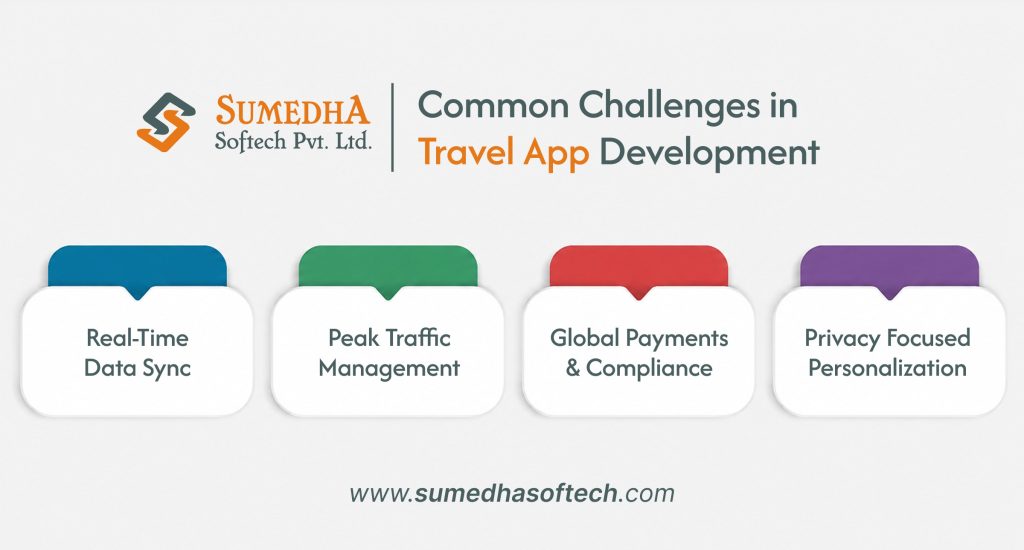
Not every platform is built perfectly; travel apps run into a specific set of problems that most of the other app categories don’t face. Being aware of them earlier is both a time and capital saver.
Real-Time Data Sync Across Multiple Systems
Flight prices, hotel inventory, and availability come from different suppliers updating constantly, and keeping all of it accurate without lag takes careful backend design.
Peak-Season Traffic Spikes
Travel apps stay quiet, then surge hard around holidays or flight disruptions. Cloud infrastructure that scales automatically handles this better than a fixed server setup.
Cross-Border Payments and Compliance
Selling across countries means handling different currencies, payment preferences, and compliance rules that vary by market, where getting it wrong becomes a legal issue.
Personalization Without Overstepping on Privacy
Users want relevant recommendations but not to feel watched. This means using behavioral data carefully and giving people real control, not a buried setting toggle.
Conclusion
At the end, a good travel app isn’t the one with the longest feature list. It’s the one that fits the type of app you actually need, covers the right features without overbuilding, and sticks to a budget that makes sense for your business. Costs will move around depending on how complex the app gets, and honestly, the projects that go smoothest are the ones where discovery and planning aren’t rushed just to get to the fun part faster. Whether you’re starting from scratch or adding onto something that already exists, partnering with a travel app development company that actually understands the industry’s demands is usually what separates an app that works from one that just barely launches.
Frequently Asked Questions
Q1. How much does it cost to develop a travel app?
Cost depends on platform choice, feature complexity, and integrations rather than one fixed number. A basic booking app costs far less than one with AI recommendations, live tracking, and multiple third-party integrations.
Q2. How long does it take to build a travel app?
The development time follows the same logic as cost: a simple MVP takes less time than a feature-heavy app with complex backend integrations. Discovery and design phases usually take longer than most people expect.
Q3. What features should a travel app have at a minimum?
At minimum, a travel app needs reliable search and booking, secure payments, and real-time updates like push notifications for delays or price changes. Everything beyond that depends on the type of app being built.
Q4. Is native or cross-platform better for a travel app?
Cross-platform works well for most travel apps today, since performance gaps have narrowed and it keeps development costs lower. Native still makes sense for apps needing deep device-level features.
Q5. Do I need a separate admin dashboard for my travel app?
Yes, in most cases. An admin dashboard is what lets your team manage bookings, listings, pricing, and user data without touching the app’s codebase directly.