How to Outsource App Development: Models, Costs & Risks
You have an app idea, a set budget, and a launch date that keeps getting closer. But what’s keeping you waiting is the development team. Hiring an in-house team can take months before anyone designs a screen, so many businesses choose to outsource app development instead.
If we have a look at the market numbers, then you will find that the software development outsourcing market is estimated at $618 billion in 2026, which shows how common the move has become. It is not risk-free, though.
PMI’s 2018 Pulse of the Profession found that 52% of projects had scope creep or uncontrolled changes, and a loose brief exposes an outsourced build just as much. Add the wrong engagement model, or a quote that leaves out maintenance and third-party costs, and a sound plan turns expensive fast.
Most of these problems are avoidable if you settle the right questions before work starts. This guide covers the outsourcing models, what an app really costs, the risks to plan for, and other essential information.
Should You Outsource App Development or Build In-House?
To be honest, the right answer depends on what you already have: a team, a timeline, and an app that either sits at the center of your business or supports it.
When Outsourcing Makes Sense
Outsourcing is a good option when speed and skills are the real gap. Workable reports that engineering roles generally take 62 days to fill on average, and an app needs more than one hire: developers, a designer, QA, and someone to run delivery. And mobile app development outsourcing gives you exactly the team already assembled.
It makes the most sense when:
- You’ve no mobile engineers in-house
- Your launch date is fixed
- You need a specialist skill for a limited time, such as payments, healthcare compliance, or AI features.
- The app supports your business rather than being the business itself.
When Building In-House Is the Better Choice
Choose building in-house when the app is your core product, and you expect to improve it for years. Deep product knowledge, daily access to the team, and full control of the roadmap then matter more than a faster start. It’s also a right choice if you already have a capable engineering team with room to take on mobile work.
| Factor | Outsource | In-House |
| Time to start | Faster | Slower |
| Cost structure | Project or monthly fee | Salaries, tools, overhead |
| Control | Shared with your partner | Full |
| Product knowledge | Needs a planned handover | Stays with your team |
Overall, if this is your first app, or you’re working to a fixed launch window, then go for the outsourced option. But if the app is your core product and you already have the engineers, build in-house.
App Outsourcing Models: What You Are Actually Choosing
Most of the guides treat the outsourcing model as the one choice. But in reality, it’s three: how the team is structured, how you pay, and where the team is based. Try settling each one separately, and the right combination becomes clear.
Team Structure: Project-Based, Dedicated Team, or Staff Augmentation
- Project-Based: A vendor takes care of the complete build, from design to launch, and you manage outcomes rather than people. It suits a self-contained app with a clear brief.
- Dedicated Team: A group of developers, usually with a designer, QA engineer, and project manager, works only on your product. You set priorities while the partner handles hiring and team management. Meanwhile, if you plan to hire dedicated developers for an app that will keep evolving, this is the model built for it.
- Staff Augmentation: Individual specialists join your existing team and work under your management. It fits when you already have engineers and a process but lack a skill or spare capacity.
Pricing Model: Fixed Price, Time and Materials, or Milestone-Based
- Fixed Price: An agreed price for an agreed scope. It works when requirements are stable, and acceptance criteria are clear. Without disciplined change control, it becomes a steady source of disputes.
- Time and Materials: You pay for the time spent. It suits products whose scope will shift as you learn from users, but it needs regular reporting so spending stays visible.
- Milestone-Based: Payments are tied to delivered and accepted work, often combined with time and materials. One vendor guide finds this hybrid gives the best balance of budget predictability and scope flexibility.
Location: Onshore, Nearshore, or Offshore
- Onshore: A team in your own country. Communication is easiest, and rates are the highest.
- Nearshore: A team in a nearby country. The time zone gap is usually about three hours or less, so most of the working day overlaps.
- Offshore: A team in a distant country. Rates are lower, and the talent pool is wider, but real-time overlap is limited, so you need clear written requirements and scheduled calls.
Freelancer or Agency?
If we compare the two, then a freelancer suits a small, well-defined task or prototype and costs less up front. You carry the management, though, and one person’s absence can stall the project. An agency brings a full team with design, QA, and project management, which is the safer option for an app you plan to launch and maintain.
Which Model Should You Pick?
Hire a dedicated development team and pay by milestone, starting with a paid discovery phase. This keeps spending visible while leaving room for scope to change, which it nearly always does.
Choose the location last, based on how many hours of daily overlap your own team needs with the developers. The one exception is a small MVP with a locked feature list. There, a fixed price with strict change control is the simpler choice.
How Much Does It Cost to Outsource Mobile App Development?
The cost to outsource mobile app development depends mostly on what you build and where your team sits. Treat the figures below as planning ranges, not quotes, because scope moves the number more than anything else.
Cost by App Complexity
A simple app currently costs roughly $15,000 to $60,000, a mid-complexity app $60,000 to $150,000, and an enterprise-grade build $150,000 or more.
| App Type | Typical Cost | Typical Timeline | What Drives It |
| Simple | $15,000 to $60,000 | 2 to 5 months | A handful of screens, basic features |
| Mid-complexity | $60,000 to $150,000 | 4 to 8 months | Custom backend, cross-platform build |
| Complex | $150,000 or more | 6 to 12+ months | Integrations, real-time data, compliance, AI |
Features increase the number. User login, payments, real-time chat, and offline mode each add design, development, and testing time.
Cost by Region
In different regions, you will discover different rates, typically falling into these bands:
| Region | Hourly Rate |
| North America and Western Europe | $100 to $250 |
| Eastern Europe ` | $25 to $70 |
| India | $15 to $50 |
However, in different guides you will discover different ranges, so it’s better to ask the vendor for a written rate card. A low rate also does not guarantee a low total. Communication delays and weak project management can raise costs in any region.
Hidden Costs Most Quotes Leave Out
- Maintenance: Annual upkeep typically runs 15 to 25% of the original development cost.
- App Store Delays: Apple’s review cycles can add about a week of sprint capacity.
- Third-Party and AI Services: Hosting, APIs, and payment fees recur monthly. One guide puts AI feature running costs at $500 to $10,000 and more a month at production scale.
- Compliance: Regulated apps need extra work. One guide cites annual security audits of $3,000 to $15,000 for HIPAA-compliant builds.
- Your Own Time: Sprint reviews, testing, and decisions take your team’s hours, and no invoice shows them.
Total Cost of Ownership: A Simple Formula
Total Cost = Build Cost + Yearly Maintenance + Third-Party Services
For example, let’s take an $80,000 build. Maintenance at 15 to 25% adds $12,000 to $20,000 a year, so three years of ownership comes to $116,000 to $140,000 before third-party services. Budget for that figure, not the build quote alone.
Risks of Outsourcing App Development and How to Avoid Them
When you outsource app development, most problems follow a few patterns. Knowing them before you sign is the cheapest protection you’ve got.
Scope Creep and Budget Overruns
This is the risk that hurts most buyers. Every small clarification becomes a billable change, and a low hourly rate stops mattering. A short requirements document with a “what we are not building” list helps hold the boundary. Pair it with a written change-order process, and keep a 10 to 20% contingency buffer for scope changes and technical surprises.
Communication Gaps and Time Zone Friction
A question asked on Monday morning and answered on Tuesday night can leave a sprint blocked. Agree on at least two to three hours of shared working time each day, hold weekly demos, and use one shared tracker. Keep a technical person on your side too. Outsourcing the coding is not the same as outsourcing product decisions.
Code Quality and Technical Debt
Chasing the lowest hourly rate often leads to the highest long-term cost, in the form of technical debt. Messy code and missing documentation slow every later release. Ask for code reviews before each release, and request documentation of decisions and dependencies, not only source code. A partner with a dedicated QA role usually ships fewer post-launch defects.
IP, Data Security, and Compliance
A breach or an ownership dispute can outlast the project by years. Sign an NDA and an IP assignment before sharing anything, and have the team work in a repository you own. Regulated apps need proof of practice, such as ISO 27001 or SOC 2 alignment. Also ask whether the vendor uses AI coding assistants and how your code and data are handled when they do.
Vendor Dependency and Lock-In
Lock-in happens quietly. If only the vendor can run or deploy the system, you’re stuck with them. Loss of technical knowledge creates lock-in when no one internally understands the code or architecture. Own the cloud accounts, ask for recorded handover sessions, and keep an internal product owner or tech lead involved.
How to Outsource App Development: From Idea to Launch
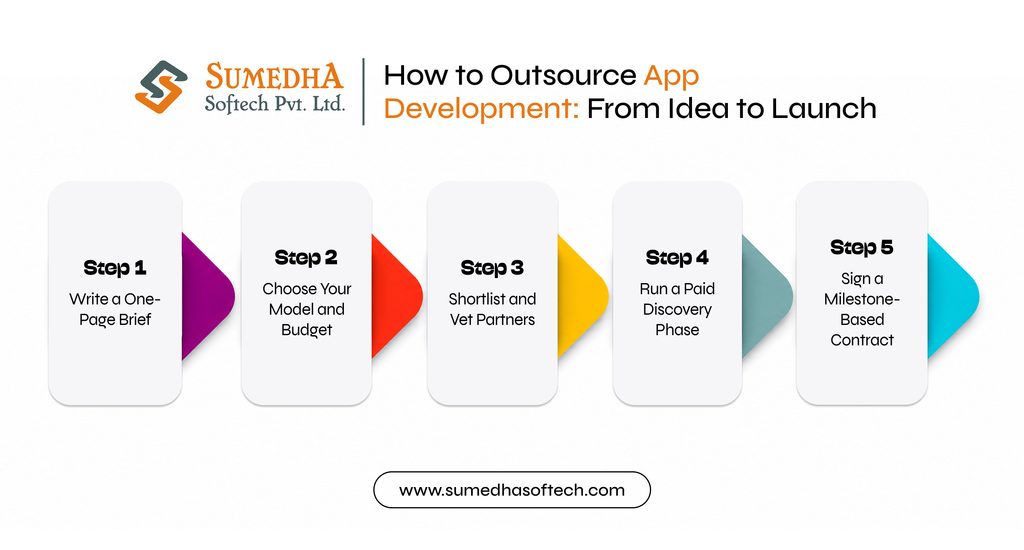
Outsourcing goes smoothly when decisions happen in the right order. Work through these steps one at a time, and do not skip the fourth, because it is what keeps scope and cost in check.
Step 1: Write a One-Page Brief
Cover who the app is for, the problem it solves, the must-have features for version one, the platforms, and your launch date. A clear brief makes every vendor quote comparable, because each team is pricing the same thing.
Step 2: Choose Your Model and Budget
Pick a dedicated team paid by milestone, as recommended earlier. Then set a budget range from the cost tiers above, and leave room for yearly maintenance so the build quote is not your only number.
Step 3: Shortlist and Vet Partners
Compare three to five vendors on shipped apps in your category, direct access to the engineers who would work on your project, and references from similar clients. The partner section below has the full checklist.
Step 4: Run a Paid Discovery Phase
Pay for a short discovery phase before the full build. Most last two to six weeks. You should come away with wireframes, a technical plan, a firm estimate, and documents you own, so you can take them to any vendor.
Step 5: Sign a Milestone-Based Contract
Tie payments to accepted milestones, with clear acceptance criteria written in. Start delivery with the riskiest feature so problems surface early, and review working software every sprint. The contract section below lists what to include.
How to Choose a Custom Software Development Company
Every proposal might look good on paper, but the goal is to judge a custom software development company on the basis of evidence, not on the pitch.
What to Check Before You Shortlist
- Live Work: Ask to see software they shipped, not slides, in your category and at a similar scale.
- A Clear Process: Sprints, demos, QA, and release steps they can explain in plain words.
- A Named Team: Who writes your code, whether they’re employees or subcontractors, and where they are based.
- Security and Compliance: Direct experience with any regulation your app falls under.
- Full-Cycle Services: Custom software development services that cover design, development, testing, and post-launch support, so one partner can see the app through.
Questions to Ask on the First Call
Ask every firm the same questions in writing, then compare the answers side by side.
- Who will write my code, and can I meet the lead engineer first?
- Can you show a live app similar to mine, and put me in touch with a client?
- How do you handle a change in scope?
- How will I see progress? Working software on a preview link beats a weekly status deck.
- How do you test code and fix bugs after launch?
- What does handover include if we part ways?
Red Flags to Walk Away From
- A price quoted before they’ve asked you any questions.
- No named team members in the proposal.
- Vague milestones with no demo checkpoints.
- Reference requests deflected behind vague NDA claims.
- Accepting your scope without a single challenge or question.
Want a cost estimate for your app?
Share your idea, and the Sumedha Softech team will suggest the right model and a realistic budget range before you commit to anything.
What to Put in Your Outsourcing Contract
A good contract turns your plan into terms both sides can act on. Have a lawyer review it before you sign.
IP Ownership and Code Repositories
In many places, whoever writes the code owns it unless a written assignment says otherwise. Add a clause assigning all work to you, with full assignment locked in upon final payment, and keep the code in a repository you own from day one.
Milestones and Acceptance Criteria
Tie each payment to a deliverable and a test it must pass. Vague terms such as “client satisfaction” leave acceptance open to dispute, so write measurable criteria, and trigger payment on written acceptance, not on submission.
Change Requests, Warranty, and Exit Terms
- Change Requests: Price and approve every change in writing before work starts. Fixing a failure against the agreed scope counts as defect correction, not a chargeable change.
- Warranty: Set a bug-fix window after acceptance, commonly 30 to 90 days, and define what counts as a defect.
- Exit Terms: State the notice period, and require source code, credentials, and documentation to be handed over within a fixed number of days.
After Launch: Support, Updates, and Handover
Launch is not the finish line. Plan maintenance before you ship.
Who Owns Support and Updates
Someone must fix bugs, patch security issues, and keep the app working with new iOS and Android versions. Decide before launch whether your partner or your own team handles it, and agree on response times for critical issues.
Documentation and Knowledge Transfer
Before the final payment, collect the architecture overview, deployment steps, and API documentation. Have someone outside the team follow them once. If they can, you can switch partners later without starting over.
Frequently Asked Questions
1. How much does it cost to outsource app development?
A simple app costs roughly $15,000 to $60,000, a mid-complexity app $60,000 to $150,000, and a complex one $150,000 or more. Budget for yearly maintenance on top, typically 15 to 25% of the build cost.
2. Is it safe to outsource app development?
Yes, when you vet the partner and structure the deal well. Check shipped work and references, run a paid discovery phase, pay by milestone, and sign an NDA and IP assignment before sharing details.
3. Is outsourcing cheaper than building in-house?
Usually for a first build or a project under a year, since you skip hiring and overhead. One comparison finds agency and full-time costs similar at one year, with in-house cheaper over three years of ongoing development.
4. Should I hire a freelancer or a dedicated development team?
A freelancer suits a small prototype or a defined task. One guide draws the line at prototypes under $15,000. For an app you plan to launch and maintain, hire a dedicated development team that brings design, QA, and project management.
5. How do I protect my app idea and code?
Sign an NDA early, before sharing detailed project information. Add an IP assignment clause to the contract, keep the code in a repository you own, and share sensitive details in stages.
6. How long does it take to build an outsourced app?
Most projects take two to twelve months or more, depending on complexity. Add two to six weeks for a discovery phase at the start.
Final Thoughts
To outsource app development well, settle your scope, model, budget, and partner in that order. For most first-time buyers, that means a dedicated team paid by milestone, after a short paid discovery phase.
If you are planning to build, Sumedha Softech can help with custom software development services, mobile app development, and dedicated development teams. Share your brief, and we will help you choose the right model and give you a scoped estimate before you commit.