
How to Choose a Banking Software Development Company
While choosing the right banking software development company, you will come across multiple companies offering different polished slides and confident pitches. But do all of them truly stand strong on the security, compliance, and scale that banking software demands?
It matters more here than in most vendor decisions. Picking the wrong one not only slows a project down, but it also lands on your customers, auditors, and balance sheet. IBM’s 2025 Cost of a Data Breach Report puts the global average breach cost at $4.44 million. But here, security is only one part of the risk a weak technology partner can bring to your business.
This guide helps you tell the difference. Throughout the blog, you’ll see what banking software development involves, which criteria matter the most, how to test a vendor’s claims before you sign, and how to compare your shortlist confidently.
What a Banking Software Development Company Does
Banking software has two layers: core and digital, and a good partner knows which one you’re building.
Core Banking Systems
The core layer is the system of record. It holds accounts, posts transactions, and applies the rules for interest and fees. Few banks build one from scratch. Most license a platform such as Temenos or FIS, so the work around it is usually integration and modernization.
Digital Banking Solutions
The digital layer is what customers see. Apps, portals, onboarding, payments. Banking application development happens here; many banking software solutions span both layers, but most firms lean one way. A financial software development company may also cover lending or payments, so check where its real strength sits.
Platform Vendor vs. Development Partner
If you talk about the real difference, then a vendor sells a finished product, while a development partner builds or adapts software around how your bank works, from custom banking software development to integration and modernization.
| Platform Vendor | Development Partner | |
| What you get | A licensed, ready-made product | Software built or adapted to your needs |
| Best for | Standard processes, quicker rollout | Unique products, integrations, modernization |
| What to check | Roadmap, configurability, lock-in | Banking track record, compliance practice, team depth |
Define Your Banking Software Requirements
You should start with defining your requirements, because vendors can only answer the questions you ask, so it’s better to settle your own answers before the first call.
Define the Project Scope and Constraints
Write down what you’re actually building. A mobile app, lending platform, or core migration? You need this clarity first, because each needs a different kind of partner. Then, based on that, list your limits: which regulators oversee you, where customer data must live, and which existing systems must the new software connect to?
Meanwhile, if AI integration in business processes like fraud review or customer support is on your roadmap, then you should speak about it at that time. Because it changes what a partner needs to understand about your data.
Set Clear Project Goals and Success Metrics
Decide how you’ll judge the project before it starts. So, consider setting a realistic timeline, name how much risk you can accept, and agree on who inside your bank makes the final calls. Projects stall fast without a decision-maker on your side.
Then add a few measurable outcomes, such as quicker onboarding or fewer manual checks. A vendor can’t hit a target you haven’t set.
Key Factors to Consider When Choosing a Banking Software Development Company
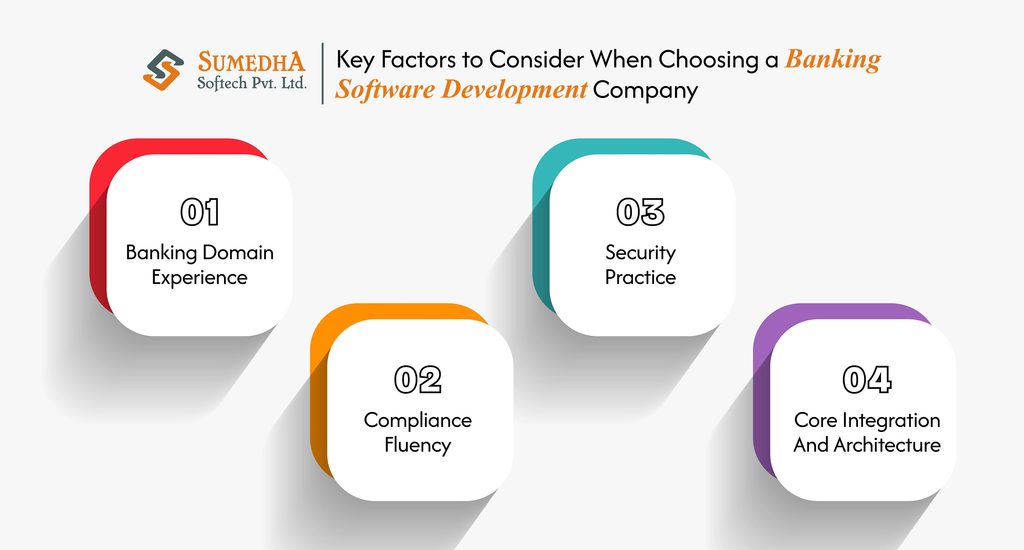
There are plenty of factors that can sway a decision, and here are some major ones that actually separate a real banking partner from a generalist.
Banking Domain Experience
Look for the products that went live in regulated environments, not just a list of industries served. Banking has its own traps. A payment flow that quietly breaks reconciliation. A login step that locks out thousands of customers at once. Teams that have shipped through problems like these tend to spot them early.
When you assess banking software development services, ask them for named projects, what the firm’s team built, and what problems they faced along the way. Honest answers about setbacks usually say more than a polished success story. Check whether the people who have delivered that work are still at the firm. Then ask to speak with a client whose institution resembles yours in size and regulatory setting. Experience with credit unions doesn’t automatically carry over to a multinational bank, and the reverse is also true.
Compliance Fluency
A partner you choose should already know the rules you operate under and design for them from day one. For card payments, that means PCI DSS. Its 51 future-dated requirements became mandatory on 31 March 2025, so a vendor still describing the older approach is behind. Account opening brings KYC and AML checks. If you operate in the EU, DORA has applied since 17 January 2025, and it shapes how you contract with technology providers.
Also ask them how the firm tracks regulatory change and who on its team owns that. Request an example where a new rule forced a design decision, and how the team handled it. Your own regional rules matter too, so name them early and watch how the vendor responds.
Security Practice
Security should show up in how a team builds, not just in a brochure. Ask them how security is handled at each stage of development, how often code is reviewed and tested, and who runs penetration tests. Other than this, also ask how access to your data is controlled, including for the vendor’s own staff. Request a recent summary of findings and how quickly critical issues were fixed.
Certifications help, but read them closely. A SOC 2 Type II report describes how a firm’s controls operated over a period of time, and an ISO 27001 certificate comes with a defined scope. Make sure that scope covers the teams and systems that will touch your project. If AI features are planned, ask where your data goes and whether it can be used to train models.
Core Integration and Architecture
New software hardly stands alone, so your partner has to work well with the systems you already run. Ask about experience with your core platform, with APIs, and with migrations that kept the bank running throughout. Replacing a core in one go is risky; many banks run new capabilities alongside the old system and move over in phases, and your partner should be comfortable with that approach.
Architecture matters just as much. Look for modular design, so one change doesn’t ripple through everything, plus a plan for traffic spikes and outage recovery. This is where enterprise application development services experience pays off, since large, connected systems behave differently from standalone apps. Ask for a diagram of a past integration, and have the team walk you through it. Also ask how they test integrations before anything touches live customer data.
Evaluate the Development Team and Communication Process
You hire a team, not a logo. So, when you hire your development partner, ask them who will actually work on your project, how senior they are, and how long they’ve been with the firm. A custom software development company that swaps people in and out mid-project can cost you months of lost context. Ask how they handle a key person leaving.
Then look at communication. Expect a clear reporting rhythm, one accountable lead, and an honest escalation path when something slips. Another important thing to check is time-zone overlap, because a delayed answer during a production incident feels very different from one during planning. Ask to meet the proposed team, not just the sales contact.
Post-Launch Support
Launch day is where the long work begins. Banking software needs security patches, regulatory updates, and performance tuning for years. Ask what support looks like once the project ends. Look for defined response times, a clear incident process, and a named point of contact. Ask whether support covers compliance updates as rules change, not just bug fixes.
Press for documentation and knowledge transfer. If your own team is not able to understand the system, then you’re tied to the vendor whether you like it or not. A good partner makes itself replaceable without making itself unavailable.
How to Verify a Banking Software Company’s Claims
Anyone can claim expertise, but evidence takes more effort to fake, so ask for it.
| Criterion | Ask For |
| Domain Experience | Named banking projects and a reference call with a similar institution |
| Compliance | A recent regulatory change and the design decision it forced |
| Security | A current SOC 2 Type II report or ISO 27001 certificate with its scope, plus a summary of recent penetration test findings. |
| Integration | An architecture diagram from a past core integration |
| Team | Profiles of the people proposed for your project and their tenure at the firm |
| Support | A sample SLA and the incident process |
Audit reports are often shared under NDA, so expect to sign one. Then call their clients, ask them what went wrong, how the vendor responded, and whether they’d hire them as a firm again. Getting the answers to these will tell you plenty.
How to Compare Banking Software Development Companies
Gut feeling is a poor tiebreaker; going with a simple scorecard keeps the comparison fair.
Build a Weighted Vendor Scorecard
Using the evidence from your checks, score each vendor from 1 to 5 on every criterion. Multiply each score by its weight (20% becomes 0.20), then add the results for a final score out of 5.
| Criterion | Suggested Weight | Vendor A | Vendor B | Vendor C |
| Banking domain experience | 20% | 1-5 | 1-5 | 1-5 |
| Compliance fluency | 20% | 1-5 | 1-5 | 1-5 |
| Security Practice | 20% | 1-5 | 1-5 | 1-5 |
| Core integration and architecture | 15% | 1-5 | 1-5 | 1-5 |
| Delivery team and communication | 15% | 1-5 | 1-5 | 1-5 |
| Post-launch support | 10% | 1-5 | 1-5 | 1-5 |
Meanwhile, treat these weights as a starting point. Building a customer-facing app? Give more weight to domain experience and the delivery team. Other than this, if you’re planning a core migration, then raise integration and architecture to 25% and trim the others to keep the total at 100.
Agree on the weights with your team before you meet any vendors. Changing them after you’ve seen the proposals defeats the purpose.
Vetting banking software partners?
Bring your toughest questions on security, compliance, and integration. We’ll give you clear, honest answers.
Contract Terms to Review Before Hiring a Banking Software Partner
A signature turns promises into obligations, so read the contract as closely as you read the pitch.
Audit Rights, Incident Response, and SLAs
Start with oversight. Secure the right to audit the vendor, and make sure that you can actually use it. Agree how quickly they must tell you about a security incident, and get their help resolving it at no extra cost or at a price fixed in advance. Write service levels in measurable terms, such as uptime and response times.
None of this is exotic. For EU institutions, DORA’s Article 30 sets baseline terms for ICT contracts, including service levels, data handling, incident assistance, and termination rights. When a service supports critical or important functions, it adds audit rights and exit strategies.
Exit Terms, Code Ownership, and Project Milestones
Plan your exit before you start. Termination rights and notice periods should be explicit, along with a transition period in which the vendor keeps the service running. Confirm who owns the code, and ask for full documentation so you’re never locked in.
Then tie payments to phased milestones. Smaller stages let you check quality early and step away before a small problem becomes an expensive one. Have your legal and compliance teams review every clause before you sign.
Conclusion
Choosing a banking software development company comes down to evidence. Define what you need, test every claim, score your shortlist honestly, and lock the protections into the contract. Do that, and the polished pitch matters far less than the proof behind it.
If you’re looking for a partner, Sumedha Softech offers banking software development services shaped around how your bank works. That covers custom platforms, customer-facing apps, integration with the systems you already run, and AI-driven capabilities. Share your goals and constraints, and we’ll help you map the right path forward.
Frequently Asked Questions
What does a banking software development company do?
A banking software development company designs, builds, and maintains software for banks, from core systems and payment platforms to mobile apps, while meeting security and regulatory requirements.
What security certifications should a banking software vendor have?
Look for a SOC 2 Type II report or ISO 27001 certificate, plus PCI DSS compliance if they touch card data. Always check that the scope covers your project.
How do I verify a vendor’s claims before signing?
Ask for named banking projects, a recent audit report, and a reference call with a similar institution. Confirm the people who did that work will be on yours.
Should a bank build in-house or hire a development partner?
Build in-house if you have the engineering depth and regulatory know-how to sustain it. Hire a partner for specialist skills, faster delivery, or integration and modernization work.
What are the biggest red flags when choosing a vendor?
Vague security answers, reluctance to share audit evidence, unavailable references, and a team that changes after signing. Pressure to decide quickly is another warning sign.