How to Choose the Right AI Development Company: A Practical Guide
Are you about to trust an AI development company with a budget, deadline, and problem your business actually needs solved? Then you already know how uncomfortable that decision feels.
Every pitch sounds confident, every portfolio looks polished, and the demo always works, because they’re built to. But none of them will tell you how the team behaves when your data turns out messy or the first version misses the mark.
That’s the part that decides everything. RAND Corporation interviewed 65 data scientists and engineers about why AI projects fail, and the causes they kept returning to are poor problem framing, weak data readiness, and inadequate infrastructure, rather than limitations of the underlying models.
This guide walks you through choosing a partner in the order the decisions come up, from checking your own readiness to reading the contract.
Get Clear on the Problem Before You Search for a Partner
Before you compare a single vendor, it’s important to first know what you’re asking them to solve and whether you yourself are aware of that.
What business problem is the AI meant to solve?
Start with one sentence that names the problem and the number it should move. Something like, “We want to cut invoice processing time in half.” If you can’t write that sentence yourself, then no other vendor can write it for you. AI solutions development often goes wrong when the target is vague, so pick a single metric and let it steer every conversation that follows. Vendors will respect the clarity, and you’ll have something real to judge their answers against.
Is your data ready for AI?
Ask vendors three simple questions related to your data. Does it exist in the volume and history the problem needs? Can your team actually get to it, or is it locked in old systems and scattered spreadsheets? And is it clean enough to trust, with consistent formats and few gaps? A yes to all three puts you in good shape, while a maybe on any of them is worth knowing now, because data problems found after signing get expensive fast. Nobody can see them from a sales call.
What if the data isn’t ready?
If your data isn’t ready, then your first engagement isn’t a build. It’s a short data assessment or discovery phase, ideally scoped and priced separately. That’s a healthy result, not a setback. Good partners will directly tell you when the data isn’t there yet, and the ones who quote a full build before looking at it are showing you something about how they work.
Which Type of AI Development Partner Fits Your Project?
The right partner depends less on who looks best and more on what you’re building. Here’s how the main options differ, and how to choose between them.
Comparing the main partner types
Each option suits a different situation. None is better across the board, so read this as a match to your project rather than a ranking.
| Partner Type | Best For | Watch Out For |
| In-house team | AI at the core of your product, with the data and budget to support it. | Slow to assemble and hard to justify for one project. |
| Specialist AI/ML firm | Research-heavy or highly technical builds | May be light on integration and software engineering |
| Full-service software company | AI that must work inside a larger product or existing systems | Depth varies, so check real AI delivery |
| Freelancers | Small experiments and proofs of concept | Continuity risk if the person moves on |
| Off-the-shelf platform | Common problems many businesses share | Limited fit, and your data may sit on their terms |
Matching partner type to project type
Generative AI development, like assistants and document tools, is often mostly about connecting a model to real workflows, which favors a full-service software company. Predictive models trained on your own historical data tend to suit a specialist firm.
When custom AI development sits at the heart of your product, an in-house team or a long-term specialist partner makes more sense. If AI just needs to fit into systems you already run, lean toward whoever knows those systems best. Most projects blend these, so choose the types that cover your hardest problem.
How to Build a Shortlist of Three
A long list is easy to make, but the skill is cutting it down to three companies worth a serious conversation.
Where to find credible candidates
Skip the sales pitches and start with people. Professionals in your field, your immediate circle, and colleagues who’ve been through an AI project will give you the most honest picture of AI development companies worth a call.
Review platforms can give you a strong idea, but treat them as a starting point. Ratings can be gathered, curated, or nudged, and a glowing page says little about how a team handled a project like yours.
Three filters to cut the list fast
Consider every name through the same three questions, and ask them the same way each time so the answers are easy to compare. Can they point to AI running in production for real customers, not just prototypes? Have they worked in your domain, so they already grasp your regulations and workflows? And can they tell you who would actually be on your project?
A company that answers all three clearly earns a place. And one that dodges any of them usually isn’t worth another hour. Keep three, and save the deeper evaluation for them.
Seven Criteria for Evaluating an AI Development Company
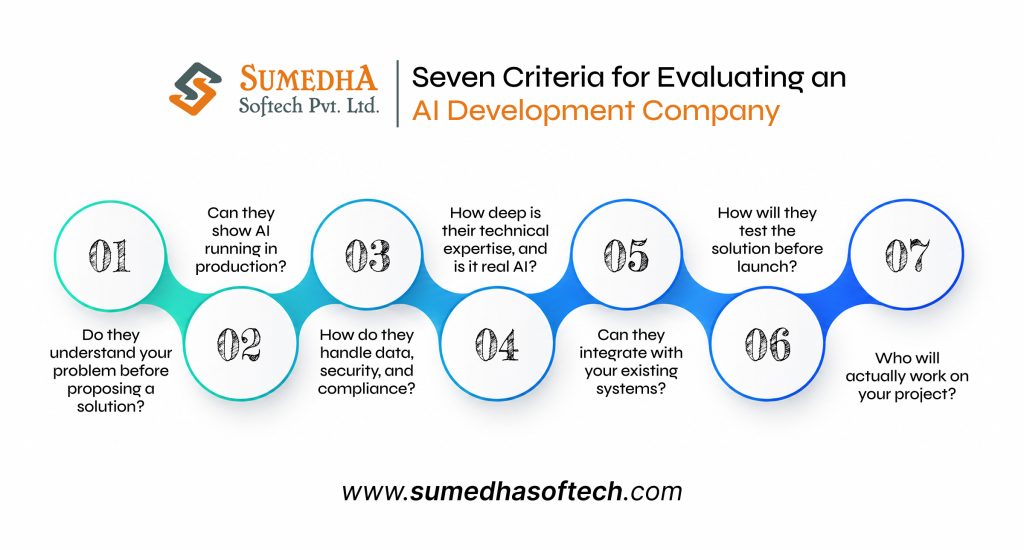
Any team can say the right things in a sales call, but are they real? So, to find that, here are seven checks that can help you find ones that can back it up when the project gets difficult.
Do they understand your problem before proposing a solution?
Clearly listen to how the first call goes. A strong team will always ask more than it tells. They want to know who uses the process today, where it breaks down, what success would be worth, and what happens to the output afterward.
Expect a discovery phase that ends with something you can keep, such as a written problem statement and a list of assumptions. That habit protects you from building a polished answer to the wrong question. Be wary of anyone who names a solution before asking about your workflow, or who quotes a firm price and timeline after a single conversation.
Can they show AI running in production?
Demos never prove everything; they’re just built to work. What counts is a system serving real users today. Ask them for two or three live deployments, how long each has been running, and what it looks like at scale. Then ask to speak with someone on the client side, ideally with the one who owned the budget.
Here, confidentiality is a fair reason to hide a name, but not a reason to hide everything, so a good partner finds a way to let you verify. If every example is a prototype, a hackathon project, or a screenshot, you’re being sold potential rather than proof.
How do they handle data, security, and compliance?
Ask them to trace your data from the moment it enters their system to the moment a result comes out, including where it’s stored and whether it ever reaches a third-party model. Specific answers sound like data processing agreements, access controls, encryption, and retention limits. Vague ones sound like “we take security seriously.” Then ask which rules apply to you and how they would design for them.
Depending on your market, that could be GDPR, HIPAA, or India’s DPDP rules, whose main duties for businesses begin in May 2027. If you serve the EU, ask about the AI Act too. Its high-risk obligations for stand-alone systems, and if compliance keeps getting postponed, then walk away from that.
How deep is their technical expertise, and is it real AI?
Start by asking which models and approaches they would use for your case, and why. A capable team can explain the trade-offs between a large language model, a smaller fine-tuned one, and classical machine learning, and it will sometimes admit that the simpler method wins.
Next, find out whether they’re tied to one model provider and what switching would involve a year from now. Then push on substance. What happens when the system meets something it has never seen? Real builders answer precisely. A rules engine wearing an AI label answers with talk of transformation and intelligence. Be cautious of any team that has one favorite tool and recommends it every time.
Can they integrate with your existing systems?
An AI model that can’t talk to your CRM, ERP, or internal tools ends up as an expensive demo. Real AI integration frequently takes as much work as the model itself, so ask about it early. Which of your systems have they connected to before? How would they handle authentication, data formats, and the moments when an upstream system is slow or down?
Look for a team that already thinks in terms of workflows, asking who uses the output and what action it should trigger. Trouble looks like a plan that runs the AI beside your existing process forever instead of inside it, or a team with strong models and no software engineering behind them.
How will they test the solution before launch?
Accuracy on a slide means nothing until you know how it was measured. Ask what test data they’ll use, who decides what counts as a good result, and how they’ll check for failures such as wrong answers stated with confidence. For language-based systems, that means testing on your real questions and edge cases, not just clean examples.
A past evaluation report, even a redacted one, shows how they really work. Good teams agree on the pass mark with you before building starts, and they plan for drift, the slow decline that happens as real-world data shifts away from what the model learned. Concern is warranted when success is defined only after delivery, or when nobody can say how failures will be caught once real users are involved.
Who will actually work on your project?
Sales teams and delivery teams are often different people. Ask for the names, roles, and experience of those who’ll build your project, and whether they will stay on it from start to finish. Ask to meet them before you sign, not after. Then look at how they work day to day.
How often will you see progress, who’s your single point of contact, and how are problems raised? Clear, plain-language updates matter as much as technical skill, because you’ll be making decisions from them. If the senior people vanish after the contract, or your contact changes every few weeks, expect the same rhythm after launch.
Choosing an AI development partner?
Talk to Sumedha Softech about your use case, data readiness, and technical requirements before you commit to a vendor.
How to Compare AI Development Proposals Fairly
Once proposals arrive, they rarely look alike. Here’s how to line them up so the comparison is fair and the decision holds up.
What does an AI project really cost?
The number on the proposal is rarely the number you’ll live with. AI development services involve more than the build itself. There’s the model usage bill, which for many systems grows with every request, plus cloud infrastructure, the monitoring that keeps the system honest, and the retraining that keeps it accurate as your data changes.
Some proposals bury these costs, and others skip them. Ask every company to split its quote into build, ongoing run cost, and support, and give each the same assumptions about users, volume, and timeline. Ask, too, what happens to the price if usage doubles. That levels the field. A low quote with no run cost estimate isn’t cheap. It’s unfinished.
How to score vendors with a weighted scorecard
Scoring turns a gut feeling into something you can defend. Rate each company from 1 to 5 on the seven criteria above, plus cost transparency, and do it before comparing notes with colleagues so no single opinion sets the tone for everyone.
Multiply each score by its weight and add them up for a total out of 5, then look at the gaps as well as the total. A company that wins overall but scores a 1 on security may not be the winner for you. The weights below suit a typical project, so adjust them to yours. A regulated business might raise security, and a team with thin internal engineering might raise integration.
Commit Without Unnecessary Risk
Choosing a company is only half the decision. The other half is how you start and what you put in writing.
Why start with a paid pilot?
A pilot shows how a team really works before the full budget is on the line. Keep it small, a few weeks on one narrow use case, with a real deliverable at the end. Agree on success criteria up front, in numbers wherever you can. Add review points where you decide to continue, adjust, or stop. If the pilot falls short, you’ve spent a fraction of the budget and learned something concrete.
What should the contract cover?
Have a lawyer review the final agreement, since this guide is educational and not legal advice. A few clauses deserve your attention. Ownership comes first, meaning who holds the code, the trained models, and anything built on your data. Say plainly whether your data can ever train someone else’s models. Make sure you can move to another provider later. Tie acceptance criteria to the pilot’s numbers, and require handover documentation so you can run the system without the vendor. Support terms and response times belong in writing too.
Who owns the system after launch?
Decide before launch, not after. Name one person on your side who owns the system. Someone has to watch performance, act on alerts, and pay the run costs you budgeted. Agree whether the vendor keeps doing that, trains your team, or shares the work for a set period. Ownership left vague tends to default to nobody.
Conclusion
Choosing an AI partner comes down to preparation and honest questions. Know the problem you’re solving, check that your data is ready, and match the partner type to the project. Then look closely at proof, security, integration, and testing, compare quotes with run costs included, and start with a small pilot. The right partner is rarely the loudest in the room. It’s the one whose answers stay specific when you push.
If you’d like a second opinion along the way, the team at Sumedha Softech is glad to talk it through. They can help you shape the problem, review how ready your data is, and map out a realistic first step.
Frequently Asked Questions
1. How long does an AI development project take?
It depends on scope, data readiness, and how many systems must connect. A focused pilot can take a few weeks, while a production system usually takes several months.
2. Do I need technical knowledge to evaluate an AI vendor?
No. You need a clear problem and the habit of asking for plain-language answers. A technical colleague can help with the security and integration questions.
3. Should the same company handle strategy and development?
It can work and keeps context intact. The risk is strategy bending toward what the company sells, so treat discovery as your own deliverable and have someone independent read it.
4. Is it a good sign if a company tells me I don’t need AI?
Often, yes. A team that says simpler automation would do is putting your outcome ahead of its sale. Ask for the reasoning, then judge whether it holds up.
5. What should I ask on a reference call?
Ask whether the project hit its goals, what went wrong and how it was handled, and whether the same people stayed. Then ask if they’d hire the company again.