
Hire Dedicated React Native Developers: A Complete Guide
When you hire React Native developers, you’re choosing a framework that lets one JavaScript and TypeScript codebase serve both iOS and Android, which is why small and mid-sized teams can ship and maintain a mobile product without building it twice.
The harder part is the hiring itself, because a poor hire can slow your releases, stretch your budget, and lead to months of rework. This guide helps you decide whether a dedicated developer is the right fit, which skills to look for, what the work really costs, where to find good candidates, and how to screen them before you commit. It also covers how to start well in the first month after they join.
Is a Dedicated React Native Developer the Right Hiring Model?
If you compare a dedicated developer, they work only on your project, usually full-time, while a development partner handles their hiring, payroll, and HR, and you assign day-to-day work. A dedicated development team is the same idea with more people. The model you pick shapes how the work feels every week, so it is worth comparing all four options before you decide.
Comparison of Dedicated, Freelance, In-House, and Agency Hiring
| Model | Commitment | Continuity | Control | Ramp-Up | Best Fit |
| Dedicated | Full-time, one project | High, partner can replace | You set daily priorities. | Short | Long-running product work |
| Freelance | Part-time, several clients | Low, ends with the contract | Depends on their availability | Quick to start | Short, fixed tasks |
| In-house | Full-time employee | High | Highest | Slow hiring takes weeks. | Software is your core business. |
| Agency | Team set by project scope | Medium, the team can change. | Indirect, through a manager | Short | A full build with a clear scope |
When Dedicated Is the Right Call
Use this rule: if the app will keep growing for six months or more, go for a dedicated one. If the job has a clear end, like a prototype or a single integration, hire a freelancer.
The reason is knowledge. Over time, a dedicated developer learns your codebase, users, and the reasons behind past decisions. That understanding stays on your project instead of walking out the door when a contract ends.
So before you hire dedicated React Native developer talent, ask whether the app will still need work a year from now. If it will, dedicated is the right call; if it won’t, then skip the commitment.
Skills to Look for in a Dedicated React Native Developer
A strong React Native developer is a good JavaScript or TypeScript engineer first, with mobile instincts on top. How much native knowledge you need on top of that depends on the app you’re building.
React Native Is Not React for the Web
React for the web draws pages in a browser using HTML and CSS. React Native uses the same component thinking but draws real iOS and Android interface elements, with no browser involved. That changes the daily work.
A mobile developer has to handle app store releases, device permissions, screen sizes, gestures, push notifications, and offline behavior, none of which a web developer deals with by default. Knowing React helps a great deal; it just isn’t enough on its own.
Match the Developer Profile to Your App
Three profiles cover most hires. Choose the one that fits your app, not the longest résumé.
- Expo-Only Developer: Expo is a toolset built on React Native that handles builds, updates, and common device features for you. This profile is a perfect match for marketplaces, content apps, internal tools, and first versions, where speed matters and few custom native features are needed.
- JavaScript Product-Layer Developer: Strong in TypeScript, navigation, state management, API work, and testing. The project’s native setup already exists, so they rarely touch iOS or Android code. That setup is often a bare workflow, meaning the team keeps and edits the iOS and Android folders itself. This profile is suitable for feature-heavy apps on a stable foundation.
- Native and New Architecture Developer: Comfortable with Swift, Kotlin, or Objective-C, and with how the New Architecture works. That means JSI, the layer that lets JavaScript talk directly to native code, Fabric, the renderer that draws the interface, TurboModules, native modules that load only when needed, and Hermes, the JavaScript engine built for React Native. This profile is a great option for apps with Bluetooth, payments, camera work, heavy animation or custom SDKs, and any team upgrading an older codebase.
How Much Does It Cost to Hire a React Native Developer?
React Native rates vary so much that the useful question is what moves the price, not what the average is.
What Moves the Rate
Three things set the price. Seniority is the first: someone who has shipped and maintained several apps costs more than a developer in their second year. Region is the second, and it often shifts the rate even more than seniority does. The third is native and New Architecture depth. Few developers can write a custom TurboModule or trace a native crash, so those who can charge more.
Typical React Native Developer Rates by Region
These hourly ranges are approximate, and published figures differ between sources, so treat them as a starting point.
| Region | Approximate Hourly Rate (USD) |
|---|---|
| United States | $70 to $150 |
| Western Europe | $50 to $120 |
| Eastern Europe | $25 to $80 |
| Latin America | $25 to $90 |
| India and Asia | $20 to $70 |
Hidden Costs: Handovers and Mis-Hires
A rate is not the full price. Freelancers show this first. Each time one leaves, the next person often needs weeks to learn your architecture, build setup, and release process, and you pay for that learning. A few handovers in a year can erase the savings.
A mis-hire costs more. A widely cited estimate, attributed to the US Department of Labor, puts a bad hire at about 30 percent of first-year earnings, before missed releases and rework. For a developer earning $100,000 a year, that is roughly $30,000. Contract roles are billed differently, but the pattern holds: lost weeks, rework, and a second search. Careful screening costs far less than any of these, which is why the interview steps later in this guide matter.
Where to Find React Native Developers
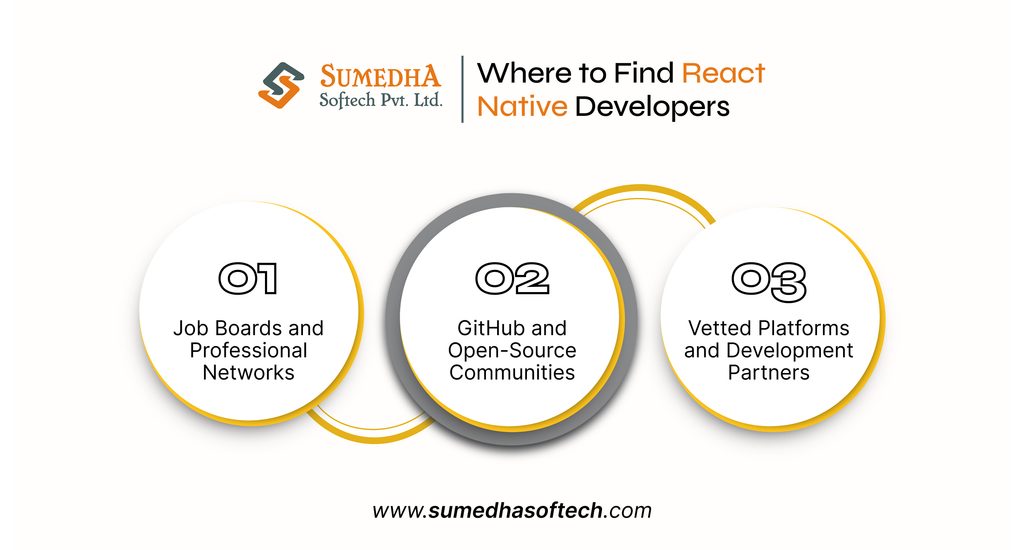
Senior React Native talent is mostly passive, meaning employed and not job hunting, so finding it takes more than posting a role.
Job Boards and Professional Networks
Job boards and LinkedIn bring volume and suit junior and mid-level roles, since active job seekers are the ones who respond. LinkedIn also lets you search profiles by skill, such as Expo or Reanimated, and message people directly. If you hire React Native app developers through a listing, write it around the real work: the product, stack, and problems to solve.
GitHub and Open-Source Communities
Open source shows how someone really works. To understand it better, browse contributors to the libraries you rely on, such as navigation, animation, or Expo packages, and read their pull requests and replies to issues. Clear, patient writing is a good sign for remote work. Meetups, community Discords, and conferences such as App. JS, Conf, and Chain React are other sources, since people who speak or attend are usually invested in the craft.
Vetted Platforms and Development Partners
Vetted talent platforms screen candidates before introducing them, which shortens the search. A development partner goes a step further by employing the developers, replacing them if needed, and handling payroll. If you want to hire dedicated developers without building a recruiting process, a partner offering React Native development services is usually the quickest route to a working setup. Before signing, ask how they screen and who replaces someone who leaves.
How to Screen and Interview React Native Developers
When you hire React Native developer talent, look for proof of real work, not polished answers.
Start With Shipped Apps
Ask for links to apps the developer has built. Check that the app is still live, when it was last updated, and what recent reviews say about crashes. Then install it and use it. Browse the whole app, switch screens quickly, and try it on a weak connection.
Next, ask them to share their screen and open the code behind one feature. Someone who built it can explain every choice; also ask which parts were theirs, since most apps are built by teams.
Interview Questions That Separate the Profiles
Pick the questions that fit the profile you need.
- Tell me about a screen that felt slow. How did you find the cause?
- Walk me through your last app release. What went wrong?
- When did you last write native code, and why?
- How did your last project handle the new architecture?
- Where does the state live in your apps, and why?
Good answers include a tool, a number, or a mistake. Vague answers are a warning.
Test Communication, Then Run a Paid Trial
Start with a short written task. Describe a small problem, such as offline support for an order screen, and ask for a half-page plan. Through this, you will be able to see how clearly they think and what questions they ask.
Then give a small paid task that takes a few hours, like one screen or a bug fix. Set the scope in writing, pay a fair rate, and review the result together. Judge how they communicate and how clean the code is.
How to Onboard a React Native Developer in the First 30 Days
A good start takes a little planning, and most early problems come from setup, not skill. So, here is what you can do in the first 30 days.
Give access on day one: the code repository, project board, chat, and test builds. Waiting for logins wastes the first week. Name one person on your side as the contact for questions. Then set a small first task, such as a bug fix, so the first code review happens within days.
Agree on the scope for the month in writing, so both sides know what “done” looks like. Set a review rhythm too: a short check-in twice a week, a code review on every pull request, and a longer talk at day 30 about what is working and what is unclear.
Contract Terms to Settle Before Work Begins
Put these in the contract before work begins.
- IP: All code and work product belong to you.
- NDA: Signed before anyone sees your code or roadmap.
- Access: Repositories, app store accounts, and signing keys sit in accounts you own, not personal ones.
- Notice: A notice period long enough for a proper handover, often 30 days.
Ask a lawyer to review the final wording.
Conclusion
A dedicated developer suits product work that will keep growing. The right profile, whether Expo-focused, product-layer, or native, depends on your app, not on the longest résumé. A rate is only part of the cost, since a mis-hire or a string of handovers costs more. Screen on shipped apps, practical questions, and a short paid trial, then start with clear access, scope, and contract terms.
If you would rather not run that search alone, Sumedha Softech can help. We offer React Native development services and can set you up with dedicated developers or a dedicated development team that works alongside your own. Share your project and the profile you need, and we will suggest the setup that fits.
Frequently Asked Questions
How long does it take to hire a dedicated React Native developer?
Plan for roughly 4 to 10 weeks, depending on seniority. Sources disagree, so treat it as a range, not a promise. Mid-level developers sit at the shorter end, senior and native specialists at the longer end. A development partner with ready developers can shorten the search.
Can a React web developer switch to React Native?
Yes, and many do. The component thinking carries over, but mobile adds app store releases, device permissions, and performance on real phones. Expect a learning period, and pair them with a senior mobile developer on complex apps.
What happens if the developer leaves mid-project?
With a dedicated model, the partner usually provides a replacement, so ask about that process before you sign. Protect the project with knowledge transfer: code in your own repository, current notes, and a handover before the last day covering open tasks, build steps, and accounts.
How many developers do I need to start?
One senior developer is enough for a focused app or MVP. Two work better if you want every change reviewed. For a larger roadmap, hire dedicated development team members in stages, starting with a lead who sets the standards.
How do I manage time zone differences with a remote developer?
Agree on two to four overlapping hours a day for calls and quick decisions. Use the rest for focused work. Keep updates, questions, and code reviews in writing so nothing waits for a meeting, and share a weekly plan so both sides know what is due.