
Dedicated Development Team vs. Staff Augmentation: Which Is Right for Your Business?
A project just got approved, but your team is tied up with other priorities, and the client wants visible progress within weeks, not quarters. This is the moment you decide between a dedicated development team and staff augmentation, often quickly and without much thought about what you’re actually choosing.
Most businesses treat both as the same move: bring in outside help, plug them in, and move on. They’re not the same. Staff augmentation fits when you already have strong internal leadership and need extra capacity. A dedicated development team fits when you need a group working together with less day-to-day management from your side.
The real difference isn’t the hourly rate. It’s who manages the work, how the costs add up over time, and what your contract needs to cover. That’s what this comparison actually examines.
Dedicated Development Team and Staff Augmentation, Explained
At first glance, both of these models solve the same problem: bringing external development capacity into a project without making permanent hires. The difference becomes clearer once you look at how that outside capacity is structured. One gives you a ready-made team, while the other adds individual specialists to the team you already have.
What a Dedicated Development Team Is
A dedicated development team is a self-contained unit that has a developer, a QA engineer, and a lead that an outside provider puts together and manages on your behalf. With them, you set the priorities and the direction. The provider handles hiring, day-to-day supervision, and getting the work done.
Let’s say a SaaS company decides to rebuild its mobile app from scratch over the next year. But it doesn’t have the internal bandwidth to manage that along with running the existing product, so it hands the entire rebuild to an external team that reports on progress weekly and makes its own calls on how the sprint gets structured. That’s the model working as intended.
What Staff Augmentation Is
Staff augmentation adds individual engineers to the team you already run. They sit in your standups, follow your existing process, and take direction from your own project manager or lead. The provider’s job stops at supplying the person, handling their pay, and replacing them if they leave. Managing the work stays entirely with you.
Take a company that already has an in-house team shipping a product on schedule, but a big release is coming up, and they’re short one backend developer for three months. Bringing in one augmented developer to work inside the existing team, under existing leadership, solves that gap without restructuring anything.
| Dedicated Development Team | Staff Augmentation | |
| Team Structure | Complete unit (developer, QA, lead) | Individual specialists added to your team |
| Daily Management | Handled by the provider | Handled by you |
| Pricing Basis | Bundled monthly retainer | Hourly or monthly, per person |
| Typical Duration | Six months or longer | Weeks to a few months |
| Delivery risk | Held by the provider | Held by you |
The Factor That Actually Decides This
Most businesses compare both these models on hourly rate and skill quality. But that’s a completely wrong comparison. A great developer added to a team with no one directing them will still stall, and an average one working inside a well-run dedicated team will still ship. The rate and the resume matter less than one thing: who is actually steering the work.
What to Check Before You Decide
Here’s the test. Do you have someone on the team, like a tech lead, senior engineer, or anyone with the time and standing to review code, set priorities, and make daily calls for an outside developer? If yes, then staff augmentation works, because that person is exactly what the model assumes exists. However, if your answer is no, then staff augmentation doesn’t fail because the developer was wrong. It failed because nobody was driving.
A dedicated team is built for the opposite situation. It comes with its own lead, which is accounted for in the price, so the coordination that staff augmentation assumes you will provide is instead built into the team itself. You’re not managing engineers; you’re reviewing outcomes at agreed checkpoints.
Why the Same Company Can Need Both
This is also why the same company can need both models at different points. A startup with a strong founding engineer might augment that person’s team for a single feature push, then switch to a dedicated team a year later once that same engineer is running different things and has no bandwidth left to direct anyone new.
Here, the question to ask before anything else, then, isn’t “which model is cheaper” or “which model gives us better developers.” It’s “who on our side has the time to manage this, starting Monday.” The honest answer to that question points to the right model faster than any comparison table can.
Need Clarity on the Right Model?
Tell us what you’re building, and we’ll help you assess which engagement model fits your team and project.
What Each Model Actually Costs
Cost is where most comparisons fall back on a simple question: which model has the lower rate? The more useful question is what you actually spend once management time, team structure, and the full cost of delivery are factored in. Here’s how the numbers work for each model.
Staff Augmentation Cost, in Practice
Staff augmentation is usually priced hourly or monthly, per person, and the headline rate looks cheaper. What it leaves out is the internal cost of running the engagement: a tech lead spending a few hours a week reviewing code and coordinating handoffs. That time is a real cost, even though it never shows up as a separate line item.
Dedicated Team Cost, in Practice
A dedicated software development team is priced on a monthly basis covering the developer, QA, and a lead’s time. Next to a single augmented hire’s rate, it looks more expensive, and for a single skill gap, it usually is. But that price already includes the coordination staff augmentation quietly pushed onto your side instead.
Where the Crossover Happens
Both get closer once a project needs more than one role at once. Add QA and part-time lead oversight to a staff augmentation setup, and the real monthly cost climbs toward what a dedicated team already charges for the same coverage, minus the management load on your end. Below that point, staff augmentation is the cheaper call compared to the dedicated team’s bundled price stops looking expensive.
Contract Terms That Decide How This Plays Out
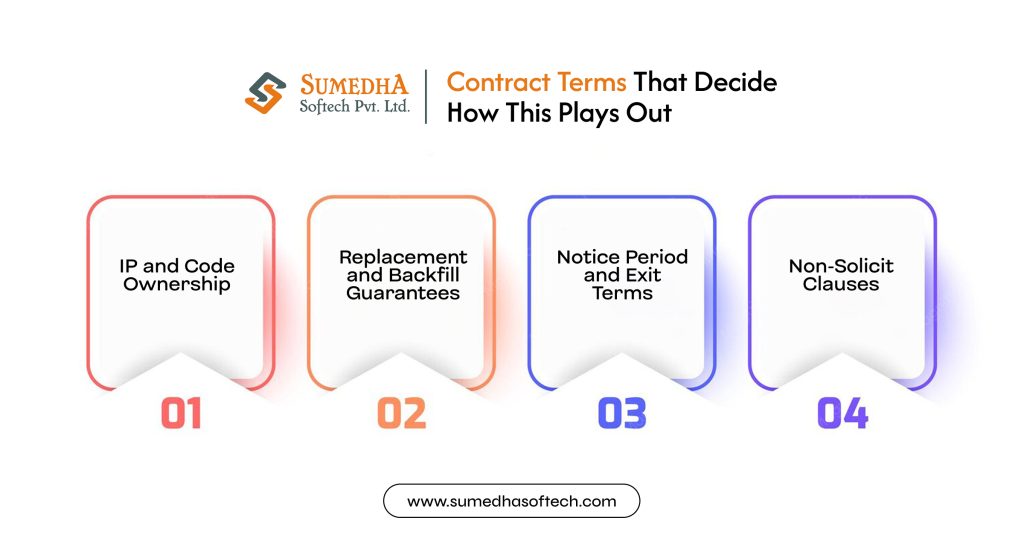
This is the part almost no comparison of these two models covers, and it’s the part that matters the most once things don’t go exactly the way planned.
IP and Code Ownership
The contract should mention that you own everything built from day one: code, documentation, architecture decisions. Don’t assume this by default, and be wary of ownership tied to final payment rather than to the work itself.
Replacement and Backfill Guarantees
People leave mid-project. Under staff augmentation, ask how fast a replacement arrives and at what cost, since a gap here stalls your work directly. Under a dedicated team, that risk mostly belongs to the provider, but confirm that a departure doesn’t reset your onboarding clock to zero.
Notice Period and Exit Terms
Every engagement ends eventually. Yet, the contract should state the notice period on both sides and what handover happens before anyone leaves: documentation, access, a knowledge-transfer window. Without this in writing, an exit turns into a scramble.
Non-Solicit Clauses
Hire a developer directly after meeting them through staff augmentation, and most contracts restrict that for a period or charge a conversion fee. Fair enough, it’s how providers protect their talent, but know the teams before you get attached to someone’s work.
Getting Team Size Right
Get this wrong either way, and you end up paying for management you didn’t need, or missing management you did.
One augmented developer is usually enough for a defined, bounded task, closing a skill gap, covering a leave, building one feature inside a codebase your team already knows. Add a second or third person without adding coordination on your side, though, and the model starts to strain, since every extra developer still needs someone reviewing their work.
A dedicated team earns its cost once the work stops being one task and becomes a workstream, new product, rebuild, ongoing development with no fixed end date. At that point, the QA and lead built into the team aren’t extra cost; they’re what keeps quality steady without pulling your own people into daily supervision.
The rule that actually holds: match team structure to how many moving parts the work has, not to how long it runs. A six-month project with one clear deliverable can still be a single hire. A six-week project touching five parts of a system might already need a small dedicated unit.
What It Looks Like When the Wrong Model Gets Picked
Neither model fails at random. Both break in a specific, predictable way, and knowing the pattern in advance is what lets you catch it early instead of three months in.
Staff Augmentation Failure Pattern
This model rarely fails because the developer wasn’t good enough. It fails when nobody internally has the time to actually direct them. A task gets assigned once and then goes quiet for two weeks. Pull requests sit unreviewed. Priorities shift mid-sprint, and nobody passes that along, because checking in daily was never anyone’s job. From the outside, it looks like a slow hire, but the real cause is an empty seat where daily direction should be.
Dedicated Team Failure Pattern
A hire-dedicated development team setup fails differently, and it can come from either side. On the client side, it usually starts with requirements that were never pinned down, so the team fills the gaps with its own best guess, and the mismatch only shows up at review, once it’s already built. On the provider side, watch for a team that isn’t actually fixed, developers swapped in and out between sprints, which erodes the one thing a dedicated team is supposed to deliver: context that builds over time instead of resetting every few weeks.
In both cases, it’s not really about the people. It’s the same mismatch covered in the deciding-factor section earlier: nobody agreed on who was actually steering.
Switching Between the Two Models Later
Moving from one model to the other mid-relationship happens more often than people expect, and it isn’t a sign the first choice was wrong. A startup often begins with staff augmentation because it’s quick to set up and the founding engineer still has time to direct someone. Six months later, that engineer is stretched across three other things, and the company converts to a dedicated team instead, sometimes keeping the same developer, now backed by a lead and QA rather than one overloaded person managing everything alone.
The switch itself comes down to two things: a clean handover of context, documentation, past decisions, the reasoning behind the code, and a short ramp-up for whoever takes over coordination. Some companies skip the switch entirely and run both at once, a dedicated team owning the core product while one or two augmented specialists cover a skill the team doesn’t have. Neither is a compromise. It’s just matching the setup to what the work needs right now.
Making the Call
If you’ve read this far, the honest answer for your own situation is probably already clear. However, here’s the same logic laid out as a quick reference.
| If this describes your situation | The better fit is |
| You have internal leadership with time to direct developers daily | Staff augmentation |
| The work is a defined, bounded task | Staff augmentation |
| You need to start within days | Staff augmentation |
| You’re building or scaling a full product with no fixed end date | Dedicated team |
| Nobody internally has the bandwidth to manage new hires | Dedicated team |
| The work spans multiple roles (dev, QA, coordination) at once | Dedicated team |
The honest version of this decision was never about which model looks more impressive. It’s about whether you’ve someone ready to steer the work, starting now. If you do, staff augmentation will get you there faster and cheaper. If you don’t, spend the extra budget on a dedicated team, because the alternative is paying augmentation rates for a project nobody’s actually running.
Conclusion
Neither model is better in general, only better for what you have going on right now. The real question was always whether someone on your side has the time to direct the work starting today, and everything else in this piece, cost, contract terms, and team size, follows from that one answer.
Sumedha Softech works with businesses on both sides of this call. Some come to us to hire dedicated developers for a single skill gap. Others need to hire a dedicated development team to own a full build from the ground up, and when that work is specifically web-focused, we help clients hire dedicated web app developers who already know the stack. For teams that just need extra hands inside a process they already run well, our IT staff augmentation services fill that gap without adding management weight on their end.
Still weighing the two? Tell us what you’re building, and we’ll help you land on the one that actually fits.
Quick Questions
1. Is staff augmentation cheaper than a dedicated team?
Per hour, usually. But once you count the internal management time staff augmentation requires, the gap narrows fast, especially once a project needs more than one role covered.
2. Who owns the code and IP under each model?
You should, under both, but get it in writing. Ownership tied to final payment rather than to the work itself is worth catching before you sign anything.
3. How fast can each model actually start?
Staff augmentation usually starts faster, since it’s adding one person to a process you already run. A dedicated team needs a short ramp-up to align on requirements first.
4. Does a dedicated team replace my in-house team?
No. It works alongside your team, owning a specific product or workstream while your team keeps its own priorities intact.
5. Can a company use both models at once?
Yes, and many do. A dedicated team can own the core product while an augmented specialist covers a skill the team doesn’t have in-house.