Food Delivery App Development: A Complete Guide for Businesses in 2027
Here’s a quiet problem many restaurant owners know well. The order comes in, the food goes out, and you still don’t know who that customer was. No name, number, or any way to say thanks or invite them back. Food delivery app development is how businesses fix that by building an ordering and delivery channel of their own.
Customers seem ready for it. In a 2025 NCR Voyix survey of US diners, 58% said they prefer to order delivery through a restaurant’s own app or website. This guide shows what that takes: how the system works, which features you need, what it costs, and how to launch without wasting money.
How a Food Delivery App Works
A food delivery app is a platform that connects four groups of people around a single order. The customer, the restaurant, the rider, and the team running the platform each see a different screen, but they all work from the same live data.
Here’s a clear explanation:
The customer picks a dish, pays, and gets a confirmation. The restaurant’s tablet buzzes, the kitchen accepts and sets a prep time. The system then looks for a rider nearby and offers the job. The rider heads to the restaurant, collects the bag, and the customer watches a dot crawl across the map until the doorbell rings. Behind the scenes, the app splits the payment between the restaurant, the rider, and the platform.
The hard part is timing. Three clocks run at once: the kitchen’s prep time, the rider’s travel time, and the customer’s patience. Send a rider too early, and they stand around while the food waits. Send them too late, and the meal goes cold. Good dispatch logic, more than any screen design, is what separates an app people reorder from one they delete.
Why Businesses Are Building Their Own Food Delivery Apps
Demand isn’t the open question anymore. Ken Research puts meal delivery alone at roughly $450 billion in 2026, which is anticipated to rise to about $489 billion in 2027. However, the growth alone doesn’t explain why a restaurant group or retailer would build instead of simply listing on a marketplace. Owning the channel changes four things:
- Brand: On a marketplace, your food sits in a list next to everyone else’s. In your own app, the screen, the tone, and the first impression are yours.
- Data: You see who ordered, what, when, and what brought them back, and marketplaces generally keep that customer information for themselves.
- Loyalty: Points, repeat-order offers, and birthday treats only work when you can reach the customer. Your app gives you the contact and the context.
- Pricing Control: You set delivery fees, minimum orders, bundles, and promotions, and you aren’t forced to raise menu prices to cover someone else’s cut.
This isn’t an argument against marketplaces, which bring discovery you can’t build overnight. Many operators use both: marketplaces to be found, their own app to keep customers.
Food Delivery App Business Models
Before you pick any feature or tech stack, pick the model. It shapes everything that follows, from how many apps you build to how much cash you need on day one.
Types of Food Delivery Apps
- Single restaurant or chain: One brand, one menu, often its own riders. The simplest to build and the strongest on brand control.
- Aggregator: Many restaurants in one app. The biggest upside and the hardest launch, because supply and demand must grow together.
- Cloud kitchen and delivery-only: Kitchens with no dining room, selling through their own app and marketplaces. Rent is lower, and the app is the only storefront.
- Grocery and B2B: Stores delivering essentials, or suppliers serving offices and caterers. These add inventory, substitutions, scheduled orders, and invoicing.
How Food Delivery Apps Make Money
Every food delivery business model rests on a handful of income streams, and most platforms stack more than one.
- Restaurant commission on each completed order.
- Delivery and service fees paid by the customer, sometimes priced by distance or demand.
- Subscriptions that give frequent customers cheaper or free delivery for a monthly fee.
- Advertising and featured listings, where restaurants pay for visibility inside the app.
The right mix depends on your type. A single restaurant app relies on direct sales and loyalty. A marketplace lives on commission and ads.
Why Margins Stay Thin
Delivery looks profitable from the outside. For both sides of the order, it isn’t.
Restaurants pay 15% to 30% on DoorDash and 20% to 30% on Uber Eats. At a 30% commission, a restaurant must raise delivery prices by about 43% to earn what it would get from the same dish in the dining room.
The platform keeps far less. Of the $33.1 billion in order value DoorDash handled in Q2 2026; only about 2.8% became adjusted EBITDA.
So margins come from order density, not a high commission.
Features Every Food Delivery App Needs
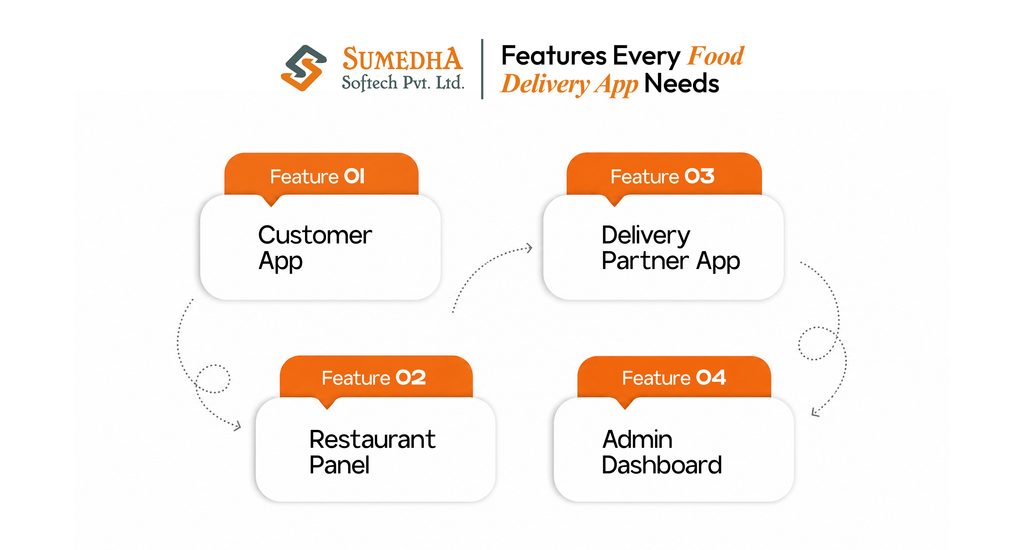
A complete platform is really four products that share one backend.
Customer App
- Sign-up, saved addresses, and location detection
- Search and filters by cuisine, diet, rating, price, and delivery time
- Menus with photos, customization options, and allergen details
- Cart, promo codes, and several payment options
- Live order tracking with accurate arrival times
- Order history, one-tap reorder, ratings, and support chat
- Push notifications, loyalty points, and referrals
Restaurant Panel
- Order alerts with accept, reject, and prep-time controls.
- Menu and stock management, including switching items off in seconds
- Opening hours and a busy mode that slows or pauses new orders
- Earnings, payouts, and sales reports
- Printer or POS integration so staff doesn’t retype orders.
Delivery Partner App
- Onboarding with ID and document checks
- Online and offline toggle, with job offers to accept or decline
- In-app navigation and pickup and drop-off confirmation
- Earnings, incentives, and cash-out options
Admin Dashboard
- A live map of orders, couriers, and zones, plus management of customers, restaurants, and couriers.
- Fee, commission, surge, and promotion settings, plus payouts and settlements.
- Franchise and multi-city panel: separate zones, menus, pricing, and reports for each city or franchise partner, with role-based access.
- Disputes and refunds: a queue showing the order timeline, GPS trail, and photos, so the team can issue full or partial refunds and record who bears the cost.
- Analytics on order volume, delivery times, cancellations, and retention.
Custom Development or a White-Label Solution
A white-label product is a ready-made app that a vendor rebrands for you. A custom build is made from scratch around your workflows. Neither is automatically better. The right pick depends on how fast you need to launch and how much of the platform you want to own.
| White-Label | Custom | |
| Time to launch | Roughly 6 to 10 weeks | Roughly 5 to 12 months |
| Upfront cost | Lower | Higher |
| Ongoing cost | License or per-order fees, depending on the vendor | Hosting and maintenance you control |
| Code ownership | Often a license, not ownership | Yours |
| Flexibility | Limited to what the vendor supports | Shaped around your operations |
| Scaling | Tied to the vendor’s architecture | Designed for your expected volume |
| Best for | Testing a market or launching one brand fast | Aggregators, multi-city plans, unusual logistics |
A GMV-based decision rule. GMV is the total value of orders placed through your app. Compare the extra cost of a custom build with what white-label fees would add up to. Here is an example, so use your own quotes: custom costs $90,000, and white-label costs $25,000 plus 2% of GMV. The $65,000 gap closes at $3.25 million in GMV. If you expect to pass that within three years, build custom. If not, go white-label.
If you outsource app development, get three things in writing: who owns the code, who owns the customer data, and what happens if you part ways.
Food Delivery App Development Process
A delivery app has a lot of moving parts, so the order you do things in matters more than how fast anyone codes.
Discovery and Planning
This usually takes a few weeks. Define the business model, your first zone, and the must-have features for version one, then study two or three competitors there. Agree on a scope document, a prioritized backlog, and a rough budget. The most useful output is a short list of what you’re deliberately not building yet.
UI/UX Design
Design moves from user flows to wireframes, a clickable prototype, and a shared design system across four interfaces rather than one. Test the courier and restaurant screens with the people who will use them: a rider with one hand free in bright sunlight, a cook with flour on their fingers. Big buttons and a few taps beat clever layouts.
App and Backend Development
Work runs in two-week sprints, each ending with a working demo. The backend leads, with accounts, menus, the order engine, dispatch, and payments first, because every app depends on them. The apps and admin panel build on top. That steady rhythm separates on-demand food delivery app development that ships on schedule from projects that drift.
Testing and Quality Assurance
- Functional Testing: Every order path, including cancellations, substitutions, and restaurants closing mid-order.
- Payment Testing: Declined cards, timeouts, double charges, refunds, and failed payment confirmations.
- Load Testing: A simulated dinner rush, so you know what happens at ten times your normal traffic.
- GPS Testing: Real drives through tunnels, dense streets, and weak signal, plus checks on battery drain.
Technology Stack and Architecture
There is no single right stack; the right one fits your team’s skills and your growth plans.
| Layer | Common Choices | What To Weigh |
| Mobile front end | Flutter, React Native, or native Swift and Kotlin | Speed to market against deep device features |
| Web panels | React, Next.js | Restaurant and admin dashboards |
| Backend | Node.js, Python (Django), Java (Spring Boot), Go | Your team’s skills and hiring pool |
| Database | PostgreSQL or MySQL, plus Redis for caching | Orders and money need consistent records |
| Real-time | WebSockets, Firebase, Kafka or RabbitMQ | Live tracking and instant order status |
| Maps | Google Maps Platform, Mapbox, HERE | Routing quality and cost per call |
| Payments | Stripe, Adyen, Razorpay, PayPal | Regional coverage and split payouts |
| Notifications | Firebase Cloud Messaging, Apple Push, Twilio, WhatsApp Business API | Delivery rate and cost per message |
Native or cross-platform? Cross-platform frameworks let one team ship to iOS and Android together, which keeps cost and time down and suits most first launches. Go native when you need heavy device features or the best possible performance.
App or website? You need apps: couriers need background GPS and reliable alerts, and frequent customers prefer an installed app. Add a web ordering page for first-time visitors and search traffic.
Monolith or microservices? Start with a well-organized monolith: one codebase split into clear modules, faster to build and easier to fix. Split out dispatch or payments later, when traffic justifies it. If the platform sits inside a larger group, treat it as enterprise mobile app development: choose for maintainability and clean integration with your POS, ERP, and accounting tools.
Food Delivery App Development Cost and Timeline
These are planning ranges, not quotes. Real costs vary widely by region, team model, and scope.
| Tier | Typical Cost | Typical Timeline | What It Includes |
| Basic | $20,000 to $50,000 | 3 to 5 months | Customer app, simple restaurant panel, basic admin, one gateway, simple courier assignment |
| Mid-range | $40,000 to $100,000 | 5 to 7 months | All four sides, live tracking, automatic dispatch, promo engine, several payment methods, reporting |
| Advanced | $90,000 to $250,000+ | 8 to 12 months | Multi-city and franchise panels, dynamic fees, AI recommendations, subscriptions, ads module, deep integrations |
What Moves the Price
- Feature Count: Every extra module adds design, build, and testing time.
- Platforms: One cross-platform codebase costs less than two native apps.
- Integrations: POS, maps, payments, and SMS each need setup and testing.
- Team Location and Model: Rates vary sharply by region.
- Scale and Compliance: High traffic and local rules add engineering work.
Costs That Continue After Launch
- Maintenance: Commonly 15% to 20% of the build cost per year
- Cloud Hosting: Grows with orders and live-tracking traffic
- Maps and SMS: Billed per request or message
- Store Fees: $99 a year for Apple and a one-time $25 for Google Play
- Support and Marketing: Often the largest ongoing line for a new platform
Security and Compliance
Payments and Data Protection
Your app holds addresses, phone numbers, live locations, and payment details, so people will judge you on how you protect them.
- Never store raw card numbers. Use a gateway that tokenizes cards, which also supports PCI DSS compliance.
- Encrypt data in transit and at rest, require multi-factor login for admins, and limit each role’s access.
- Run penetration tests before launch and after major releases.
- Follow the privacy law where your customers live, such as GDPR in Europe or CCPA in California. India’s DPDP Rules, notified in November 2025, bring most duties into force by 13 May 2027.
Food Safety and Platform Regulations
- Restaurant licenses. Verify food licenses or health permits at onboarding, such as FSSAI details in India or local health permits in the US.
- Allergen accuracy. Let restaurants flag allergens clearly, and make wrong-order complaints easy to raise.
- Courier and fee rules. Worker classification, insurance, and fee caps differ by city, so make fees configurable per zone.
- Tax invoicing. Generate GST, VAT, or sales tax records correctly from day one.
Launching and Growing the Platform
Start With One Zone
Pick one dense neighborhood, not a whole city. Launch quietly to a small group, fix what breaks, then submit to the app stores, leaving time for review. Track a short list of numbers from week one:
- Orders per day and per restaurant
- On-time delivery rate and average time from order to doorstep
- Cancellation and refund rate
- Share of customers who reorder within 30 days
- Profit per order after courier and payment costs
Set thresholds before launch, and expand only when the numbers hold for several weeks and each order earns money on its own.
Build Supply Before Demand
A customer who opens an empty app rarely comes back. Sign restaurants first, enough that someone in your zone has a real choice at dinnertime. Recruit couriers next, then bring in customers through local offers. If you don’t want to run a fleet yet, third-party dispatch is a valid launch option: services such as Uber Direct and DoorDash Drive in the US supply riders on demand.
Planning your own food delivery app?
Share your idea, your city, and the features you need. The Sumedha Softech team will send back a clear cost and timeline estimate for your build, with no obligation.
Food Delivery App Trends for 2027
AI across the whole order. Personalized menus, dispatch that predicts kitchen delays, and demand forecasts that show where to recruit couriers are the practical uses today. They work best after a few months of order data.
Agentic and voice ordering are still early. DoorDash recently launched Ask, an AI assistant that helps customers find restaurants and build grocery baskets, and other platforms are testing agents that order on a customer’s behalf. Voice ordering for restaurants has had mixed results. Keep your menu and order data clean and available through APIs so you can adopt these later, but don’t delay launch for them.
Quick commerce and hyperlocal speed. In India, platforms run small dark stores and promise deliveries in about ten minutes. Speed raises expectations everywhere, but quick commerce is capital-intensive with thin margins, so it suits dense areas and well-funded operators more than a first launch.
Choosing a Food Delivery App Development Partner
A good custom software development company will ask about your business before it talks about technology. Compare candidates on these points:
- Relevant Experience: Ask for live food, grocery, or logistics apps, and try them yourself.
- Multi-Sided Skills: They should understand the customer, restaurant, courier, and admin flows together.
- Clear Process and Ownership: Regular demos, honest estimates, and written ownership of your code and data.
- Security and Support: How they handle payments, and who fixes problems at 8 p.m. on a Saturday.
Questions worth asking:
- What would you cut from my first version, and why?
- How will you estimate and test arrival times and dispatch?
- Who will actually work on my project, and will they stay on it?
- Can I speak to a client whose app has been live for over a year?
Conclusion
A food delivery app is less about the app and more about the operation behind it. The businesses that do well start small, choose a business model they can explain in a sentence, protect their customers’ data, and treat order density and timing as seriously as design. Pick custom or white-label to match your expected volume, launch in one zone, and let real orders guide what you build next. Do that, and the app becomes a channel you own.
If you want a technical partner for the build, Sumedha Softech works on mobile app development, custom software, cloud and AI solutions, and can supply dedicated developers to extend your own team. Whether you need a full custom platform or help with one part of it, a short conversation about your zone, model, and timeline is a good place to start.
Frequently Asked Questions
1. How much does it cost to build a food delivery app?
A mid-range build, covering customer, restaurant, courier, and admin sides, typically costs $40,000 to $100,000. Exact numbers depend on features, platforms, and team location, so the cost and timeline section above breaks down what each tier includes before you commit to a budget.
2. How long does it take to develop a food delivery app?
A mid-range food delivery app usually takes five to seven months from discovery to launch. Simple versions can ship sooner, and advanced platforms take longer. The cost and timeline section above shows what drives that range and what each tier includes.
3. What is the difference between a food ordering app and a food delivery app?
A food ordering app lets customers browse a menu and place an order, which the restaurant then fulfills, often through pickup or its own staff. A food delivery app adds the logistics layer: courier assignment, live tracking, delivery fees, and payouts. Delivery apps are therefore bigger builds, with more users and more moving parts.
4. Do I need my own delivery fleet to launch?
No. Most new platforms start with restaurants’ own riders or a third-party dispatch service, then build a fleet only when volume in a zone justifies the fixed cost. The launch section above explains when each option fits.
5. Should I build for iOS, Android or both first?
Start with the platform most of your customers use, or build cross-platform to cover both at once. That is usually cheaper than two native apps, as the technology stack section explains.