
How to Hire a Dedicated Development Team
Hiring a dedicated development team in 2026 is so much easier than hiring individual developers. In fact, these days, more businesses are adopting to hire dedicated development team rather than going through the complexity of recruiting internal developers.
As technology is continuously evolving, companies need development teams that can adapt to changes quickly, scale when required, and bring specialized expertise to their projects. However, getting this all with your in-house team is not that easy; it demands a big budget, lengthy recruitment processes, and ongoing efforts to find and retain the right technical talent.
But it all gets easier when businesses partner with a dedicated development team. Instead of spending months searching for the right talent, companies can quickly access experienced developers, engineers, designers, and other technology specialists who work as an extension of their internal team.
This approach gives businesses more flexibility to scale their teams based on project requirements, maintain better control over development, and focus on their core business goals while technical experts handle product execution.
In this guide, we’ll understand how to hire a dedicated development team, the key benefits, core factors to consider before hiring, and a lot more that perfectly helps you choose the right development partner for your business.
What is a dedicated development team?
A dedicated development team is a group of software development team members hired by a business to work exclusively on its projects for a specific period of time.
Unlike traditional outsourcing, where a company assigns tasks to a third party and waits for the final delivery, a dedicated team works as an extension of your internal team. They collaborate closely with your business, product managers, and stakeholders and work according to the company’s processes and procedures.
This model gives businesses access to skilled developers, designers, QA engineers, DevOps, and other technology experts without the challenges of building a complete in-house team.
How Does a Dedicated Development Team Work?
IT staff augmentation works in the same way as your internal technology team, but the difference is that it is managed by an external partnership. The working process usually starts by understanding your business goals, project requirements, and technical needs.
On the basis of that, the team structure is created as:
- Frontend and backend developers
- Mobile app developers
- UI/UX designers
- QA engineers
- DevOps specialists
- Project managers
Once the team is assembled, they work exclusively on your project, follow the same workflows, communication methods, and development processes. Meanwhile, you don’t have to worry about anything; the development partner handles talent acquisition, team management, and operational responsibilities, allowing businesses to focus on strategy and growth.
Dedicated Development Team vs. Traditional Outsourcing
Even though both of these models help businesses access external technical expertise, their way of operating is very different.
| Dedicated Development Team | Traditional Outsourcing |
| Built for long-term collaboration | Usually focused on completing a specific project |
| Team works as an extension of your internal team | Vendor manages most project decisions |
| You’ve more control over workflow, priorities, and communication | Limited involvement in daily development activities |
| Team size can be adjusted as per project requirements | Resources are usually fixed based on initial scope |
| Developers gain a deeper understanding of your product and business goals | Team mainly focuses on delivery requirements |
| Perfect option for evolving products and continuous development | Better suited for clearly defined, one-time projects. |
Why Businesses Hire Dedicated Development Teams in 2026
Building custom software means hiring full-time developers or handing a project off to an outsourcing company and hoping for the best. But in 2026, businesses are increasingly comparing dedicated development teams vs. staff augmentation to find an engagement model that offers the right balance of flexibility and control. Here’s why these models are gaining attention.
1. Faster Access to Specialized Skill Sets
Finding engineers who already know cloud architecture, AI integration, or DevOps can take months of interviews and false starts. But going with a dedicated team comes with that expertise built in, so work starts in weeks instead of quarters.
2. Lower Overhead Than Building An In-House Team
Every full-time hire brings salary, benefits, equipment, and office space with it. But going with a dedicated team lets a business add engineering capacity without carrying those fixed costs, which matters a lot when a company is testing a new product or entering a new market.
3. Flexibility to Scale Up or Down With Project Needs
Roadmaps shift. A team that’s dedicated to the project can grow during a heavy build phase and shrink when moving toward maintenance; this is something that is nearly impossible to do with a permanent staff.
4. Full Control Without the Management Burden
A dedicated team is not a black box that handles a fixed scope somewhere off-site. Instead, they join standups, take regular direction from the business, and work inside its existing workflow, while the vendor quietly handles payroll, HR, and infrastructure in the background.
5. Continuity Across Long-Term Projects
Freelancers rotate in and out, and every departure means someone new has to relearn the codebase. A dedicated team stays through the entire lifecycle, from early planning to years of post-launch support, so the knowledge never walks out the door.
When Should You Hire a Dedicated Development Team?
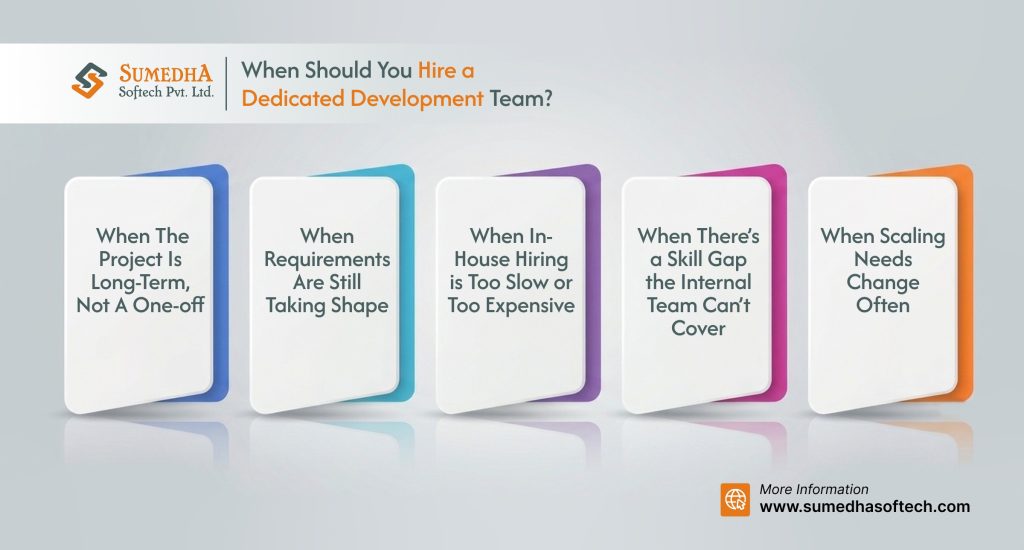
Now, if you’re confused and wondering when you should hire a dedicated team, then here is a clear answer for this.
1. When The Project Is Long-Term, Not A One-off
If you’re working on any custom software development and that work is going to take six months or longer, or the product keeps evolving after launch, at this point, hiring a dedicated team makes more sense than a project-based contract. Short-term work with a fixed end date usually doesn’t need this kind of setup.
2. When Requirements Are Still Taking Shape
Some projects have a clear spec from day one, while others don’t, and the reason behind this is that the business is still figuring out what the product needs to become as users respond to it. So, here a dedicated team can adjust as priorities shift, which a fixed scope contract can’t really do.
3. When In-House Hiring is Too Slow or Too Expensive
Opening a full-time role, screening candidates, and onboarding someone can take two to three months of time before they’re even productive. If the business needs engineers working now, or doesn’t want the overhead of full-time salaries and benefits, a dedicated team fills that gap.
4. When There’s a Skill Gap the Internal Team Can’t Cover
If nobody in the house knows a specific stack, like React Native or a particular cloud platform, bringing in a dedicated team is usually faster than training existing staff or hoping a single new hire covers it all.
5. When Scaling Needs Change Often
Some months need five developers, others need two. A dedicated team can flex with that, which is hard to do with permanent employees who need steady, full-time work to stay on payroll.
Hire a Dedicated Development Team at Sumedha Softech
Most of the businesses that come to us to hire dedicated developers have already tried hiring on their own first and run into the same problem. Good engineers take months to find, and by the time they’re actually onboarded, the timeline has already slipped past where it was supposed to be. And that’s exactly where our dedicated team mode exists to close.
Step 1 – Share Your Requirements
The hiring process starts with a conversation about what you’re building, what skill you’re looking for, and the size of the team that makes sense. With us, you don’t have to be involved in any lengthy forms or sales pitches, just a straightforward talk about your project.
Step 2 – Get Matched with the Right Developers
On the basis of your need, we put together a shortlist of developers with relevant experience, whether that’s React Native, cloud architecture, AI integration, or something more specific to your industry.
Step 3 – Review Profiles and Interview Candidates
You will get to see detailed profiles and talk to the developers directly before making any commitment. This will be your team, so you should be the one deciding who’s on it.
Step 4 – Finalize the Team and Engagement Terms
Once you’ve finalized the developers, we will settle the practical details together, including team size, timelines, and other information like how the engagement will run month to month.
Step 5 – Onboard and Get to Work
After the finalization, the team gets access to your tools, joins your workflows, and starts working like an extension of your own staff, attending meetings, taking direction, and working as per your roadmap.
Step 6 – Scale as Your Project Evolves
Throughout the working tenure, whenever you need change, you can add developers, adjust the team’s focus, or bring in different skills, all without going through another hiring cycle.
Common Mistakes to Avoid
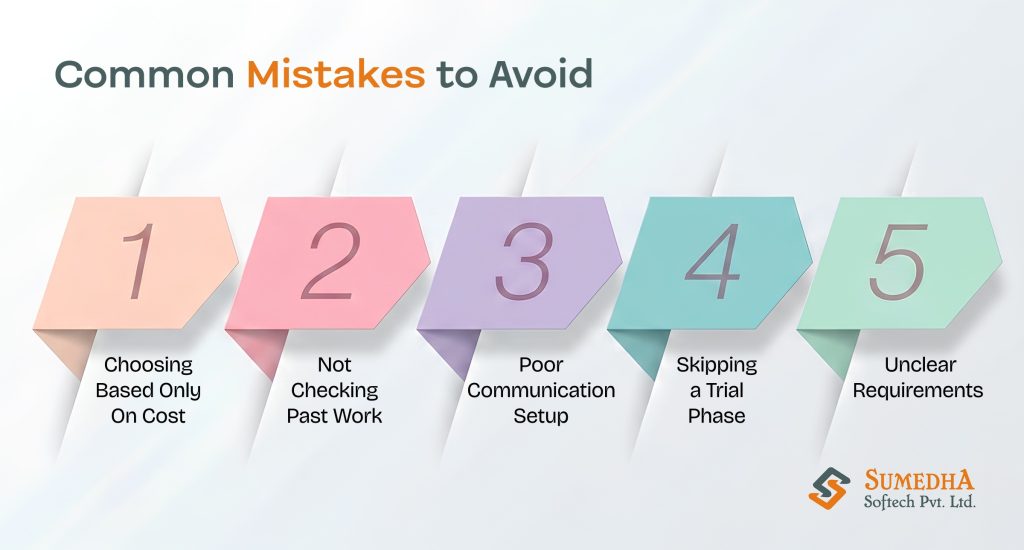
When you choose to hire a dedicated development team, here are some common mistakes you don’t want to make:
- Choosing Based Only On Cost
Low-cost software development outsourcing usually comes with a catch, whether that’s junior engineers, less oversight, or corners cut somewhere you won’t notice until later. Cost matters, but it should not be the primary thing that will be deciding your hiring.
- Not Checking Past Work
This can be a very big pitfall; checking a team portfolio and client history tells you whether they’ve actually handled problems like yours before or whether your project would be the first real attempt at it. Skipping this can cost you heavily.
- Poor Communication Setup
Without agreed tools, overlapping working hours, and a regular check-in rhythm from day one, small misunderstandings pile up fast and turn into missed deadlines before anyone notices what went wrong.
- Unclear Requirements
Unclear scope at the start rarely gets clearer as the project moves along. When priorities and expectations aren’t spelled out early, the team ends up filling in the blanks themselves, and what they build rarely matches what you actually have in mind.
- Skipping a Trial Phase
Committing to a full team before working together on a smaller piece first is a gamble. A short trial period shows you how the team communicates, handles feedback, and fits with how you work before you’re locked into a longer engagement.
Conclusion
Here comes the end of this comprehensive guide. In 2026, hiring a dedicated team is not about outsourcing anymore; it’s about building the right extension of your business. As technology and product cycles are moving faster, relying on internal hiring can create bottlenecks and can also be expensive.
So, hire dedicated web app developers gives you the flexibility to scale, access specialized expertise, and the ability to move faster without compromising on quality or control. If you are building a new product, scaling an existing product, or filling critical gaps in skills, this model is practical and efficient for doing so.
If you’re looking forward to hiring a dedicated development team, it’s worth having a conversation with Sumedha Softech to understand how this model would actually work for your project before you commit.
Frequently Asked Questions
Q1. What is the difference between a dedicated development team and outsourcing?
A dedicated development team works as an extension of your in-house team, following your processes, tools, and communication style. In contrast, traditional outsourcing usually involves handing over a project to a vendor with limited involvement in day-to-day development.
Q2. How much does it cost to hire dedicated developers?
The cost depends on several factors, including team size, developer experience, technology stack, and location. Instead of fixed pricing, most companies offer flexible engagement models based on your project requirements.
Q3. How long does it take to set up a dedicated development team?
Typically, it can take anywhere from a few days to a few weeks, depending on the complexity of your requirements and the size of the team. Compared to in-house hiring, this process is significantly faster.
Q4. Can I scale the team up or down later?
Yes, one of the biggest advantages of a dedicated development team is flexibility. You can increase or reduce team size based on your project phase, workload, or business priorities.
Q5. Is a dedicated development team suitable for startups?
Absolutely. Startups benefit from faster hiring, lower operational costs, and access to experienced developers without committing to full-time salaries, making it an ideal model for building and scaling products efficiently.